
The Google Site Reliability Engineer Interview Guide
This interview guide covers the loop for Site Reliability Engineer candidates interviewing at Google. It's been written with the help of a Staff Site Reliability Engineer and 2 Site Reliability Engineers who have worked at Google. Thanks to candidates who are interviewing there in real-time, we've managed to keep this up-to-date with questions asked as recently as last month. This guide covers the full loop and lists recently reported questions from 2026.
The Google Site Reliability Engineer interview loop runs through these stages:
- Recruiter screen
- Technical phone screen (a second phone interview in some loops)
- Onsite, 4 or 5 interviews:
Practical Coding & Scripting
Linux Internals or Networking (your pick)
Troubleshooting
Non-Abstract Large System Design (NALSD)
Googleyness & Leadership - Hiring committee review and team match (the order varies)
Google hires SREs on 2 tracks, and this guide covers the Systems Engineering track (SRE-SE).
If your recruiter has put you on the Software Engineering track (SRE-SWE), please switch to our Google Software Engineer interview guide to see how your phone screen and most of the onsite will go. Some Software Engineering-track candidates were asked to sit an extra NALSD round after their SWE loop, the details of which this guide covers.
Our SWE guide also covers the Google Hiring Assessment, which Google may ask you to take if you apply online, irrespective of track or role. We suggest that you glance at it once.
How Google Evaluates Site Reliability Engineers
Google assesses every candidate for a role against the same rubric. Every interview in the loop, the SRE-specific ones included, is scored against the same 4 attributes Google uses for all its hires, and they're what your interviewers write their feedback against:
- General Cognitive Ability (GCA) is measured against how well you break down problems you aren't familiar with and is a focus upon how you think, essentially. This is the most heavily weighted dimension.
- Role-Related Knowledge (RRK) measures how deep your knowledge of the craft goes. For an SRE, the topics would cover code, Linux, networking, troubleshooting, large-system design, etc.
- Leadership, more specifically “emergent leadership” is measured as your ability to read the room and pick your moments to take charge and have the restraint to step back when it doesn't. Naturally, the expectations change with level.
- Googleyness: a mix of intellectual humility, comfort with ambiguity, bias to action and collaborative instincts.
Recruiter Screen
This is a 30-minute screen over the phone or on Meet with a recruiter. They’re going to do a background check and get a read on your level to set the expectations for the rounds to follow.
The questions they’ll ask are fairly straightforward:
- What about your experience do you think is most relevant to Google?
- Are you more interested in the software engineering SRE path or the systems engineering SRE one?
- Would you choose Linux or networking for the domain round?
- What’s your timeline like? Are you currently interviewing anywhere else?
The recruiter may put you on the SRE-SWE track if your strongest work is in DSA.
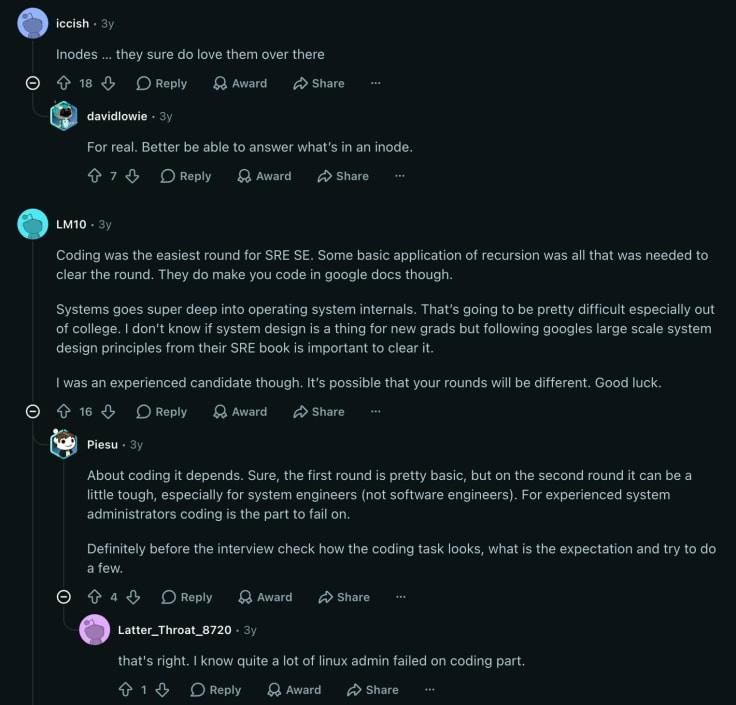
A commenter explaining that the recruiter picks your track based on your past work, Reddit
Technical Phone Screen
This is a 45-minute interview over video with a Google engineer, and is positioned as the gatekeeper to the onsite. During the round, you'll code in a shared Google Doc without the luxury of a compiler or autocomplete.
The screen often pairs a scripting question with Linux internals. A Prepfully candidate's scripting half was a file-manipulation problem about finding duplicates, and their Linux half went from inodes to the commands they'd use to check networking and performance.
Other candidates have described a practical prompt where you parse an input file and return a value computed from its contents. Once that works, the interviewer starts asking what happens to your code in production (e.g. an empty file, data that won't fit in memory), and how you'd know that a line failed to parse. Expect even simple questions to keep getting reframed around production scale.
A few candidates reported a second screen, either to cover breadth (the first was coding, so the second was Linux) or because their performance in the first one was borderline.
Google Site Reliability Engineer Onsite Interviews
The onsite is 4-5 interviews of about 45-60 minutes each. Google conducts these in person for the most part but it’s possible that a few interviews are over video too. When a round runs over video, you work in a shared doc, the same as in the phone screen. When run in person, you can usually choose whether to sit the rounds on a single day or spread them over days.
SRE interviewers each own one topic, like programming, UNIX internals, networks or troubleshooting, so the loop is a set of separate conversations instead of 4-5 reads on the same skill.
You'll typically face:
- Practical Coding & Scripting
- Deep Systems: Linux Internals or Networking
- Troubleshooting
- Non-Abstract Large System Design (NALSD)
- Googleyness & Leadership
Some loops add an interview after the onsite, either to cover a topic the day missed or to repeat one where the performance was borderline.
1. Practical Coding & Scripting
Google asks every SRE candidate to code something, whatever their background. You can code in the language you’re most comfortable in. This round evaluates whether you can write the kind of code an SRE writes in the course of running production. More specifically, that means tooling that handles real-world data as it arrives, and keeps working once that data gets large or malformed.
- Write a script that does what tail does, on a file too big to load into memory.
- Write a script that pings a list of hosts, finds the slow ones and prints specific data for each.
- From top's output, extract the running processes using more than 20% CPU.
- Given a filesystem structure, return the total size of a folder.
- Find the most frequent IP address in a log file.
- Using Bash and cron, write a script that runs on the last Friday of every month.
2. Deep Systems (Linux Internals or Networking)
This round is a deep systems conversation on a topic of your choosing between Linux internals or Networking. You’ll have to let your recruiter know about your choice ahead of time so that your interviewer can shape the questions around these strengths.
The interviewer’s agenda is to test the depth of what you know, so their questions will keep coming until they hit the bedrock. The interviewer typically opens with a broad prompt and you’re expected to drive the conversation from there.
To help you understand how this round would play out, we’ll detail a classic prompt: “What happens when you type a URL into a browser and hit enter?”
You're expected to take it end to end, starting at DNS and going all the way down to the kernel, and then defend each layer when the interviewer stops you to ask a few questions.
If you picked Linux, the round becomes a run of questions on how the OS works. Candidates have reported questions like:
- How do interrupts and signal handlers work?
- What does a signal mask do?
- What are the process states?
- What is the difference between a hard link and a soft link?
- What is in an inode?
- What does system load measure?
- CPU usage on a machine has spiked. What do you do?
- How would you find and clean up zombie processes?
- What happens to a tmux session when the SSH connection drops?
- How does traceroute work?
It's also possible the interviewer has you work through a hands-on task. A Prepfully candidate was given ping and asked to build on it.
If you picked networking, the interviewer takes the URL prompt out along the wire, hop by hop, asking what a packet capture would show at each point.
Prepare for questions like:
- Walk me through a TCP connection at the packet level. What is the TIME_WAIT state for?
- Walk me through how DNS resolution works. What is the difference between dig and nslookup?
- Explain the QUIC protocol and what it improved on compared with TCP.
- What does it tell you when a service is timing out and the packet capture shows SYNs going out but no SYN-ACK coming back?
- A customer can't SSH into a remote system. Walk me through how you would troubleshoot it.
- What does a DNS TTL control? Why does lowering it before a migration help?
See the full list of questions for this loop in our free Google SRE interview question bank.
3. Troubleshooting
In this round, the interviewer will talk you through the simulation of a production incident to evaluate your approach to arriving at a fix.
You’ll be scored on how well you:
- Scope the problem
- Form hypotheses
- Rule out hypotheses
- Locate the issue
- Fix the issue
The interviewer typically kicks off with a vague report, often a service throwing errors or timing out after a deployment. You’ll have to verbalize the steps of your investigation by saying which command you'd run and what you expect to see.
They'll respond with what it shows and the round progresses in a back-and-forth manner, one hypothesis at a time. Each time you discard a hypothesis, expect to be asked why you did so. You won’t be handed a dashboard so you have to explicitly ask for any number you need.
One candidate's round started from an architecture diagram the interviewer pasted into the shared doc. Over the hour they worked through 7-8 infrastructure issues on it, covering performance and I/O, memory, load balancing and CDN behaviour, with a few on firewalls and security.
Candidates have reported facing questions like:
- A production service started returning errors after a recent deployment. How would you find the root cause?
- What are your short-term and long-term fixes?
- A distributed database is showing inconsistent data. How would you investigate this?
- A cron job that has run fine for months failed last night with no error in its log. What’s happening here?
- Disk on a host is at 100% but du doesn't add up to that number. What's going on?
- A process is stuck in D state and won't die. What can you do?
- A pod restarts every few minutes with exit code 137. What's your first move?
At Google, we treat troubleshooting as a core SRE skill. Breaking a problem into smaller pieces -> identifying possible causes -> triaging -> working through them systematically is seen as a transferable skill from any domain, whether you learned it debugging code, building hardware or something else entirely. How you search and investigate matters just as much as working out an answer.
The method is second nature to anyone who's been on call, so you'll rely on instinct heavily here. That makes it the round people under-prepare for, because it doesn't feel like something you can study. And you can’t, not alone at least.
From the first minute, the interviewer is judging whether your questions and calls are matching the level you’re interviewing for, so if that impression teeters, it’s kinda hard to win back.
This is why we suggest you dry-run this round at least once with one of our coaches, who are Google interviewers themselves. They'll tell you what Google is favouring in candidates at your level right now and how to show it. You should strongly consider arming yourself with such leverage in a field this competitive.
Fill out a quick form to get matched with an expert or book directly with a Google SRE interview coach of your preference.
4. Non-Abstract Large System Design (NALSD)
This is the SRE version of the system design interview. It evaluates whether you can take a design beyond the diagram and size it properly. You’ll have to go deep into details, down to the number of machines and what happens to it when something fails.
You'll get an open prompt for a large system. For example, you might be asked to design a system that joins different types of log entries written in multiple datacenters so they can be analysed together. You start with a design that works in principle. Then the interviewer scales it up, usually by sharply increasing one of the requirements. You’ll have to adapt your design to it so it still holds.
NALSD is also how Google's SREs design systems at work. The method runs in 2 phases, a basic design and then a scaled one, and these are the questions to ask yourself out loud in each:
- Basic design
- Is it possible? If hardware weren't a constraint, what would you build to meet the requirements?
- Can we do better? Can the design get meaningfully faster or smaller? Can it get more efficient, for example O(ln N) where it was O(N)?
- Scaled design
- Is it feasible? Can it scale within real limits on money and hardware, and what distributed design would that take?
- Is it resilient? Does it fail gracefully when a component dies, or when a whole datacenter goes down?
- Can we do better? The same question again, on the scaled design.
You’ll likely bounce between these questions during the round and that’s OK. We strongly suggest you learn this method from the source of truth. Google's SRE Workbook has a full chapter on NALSD, with a worked example built on ad click logs, and it is worth reading closely before the round.
For every component you should be able to say roughly how much it handles and stores so don’t get too hung up on arriving at the exact numbers. The interviewer is more interested in understanding if you’re able to articulate where you're trading reliability for cost and how hard it would be to build each piece.
5. Googleyness and Leadership
In this 45 minute round, you’ll face 4-5 behavioral questions. These questions typically open with “tell me about a time when” or “describe a decision you made” with a few follow-ups that’ll focus on what you did next or what came of it.
Since you’ll be reaching from your experience and past, Google will focus on evaluating communication, time management, decision making, flexibility, initiative, leadership, organization, and problem solving.
Some candidates recently mentioned that their behavioral round had a technical design discussion. They had a retrospective conversation about stuff they’d already built and had to defend its architecture to the interviewer.
In this round, you’ll face questions like:
- Tell me about a time you made a pretty significant technical decision based on incomplete data.
- Walk me through a situation where someone on your team disagreed with your technical approach.
- Talk to me about a project where you realised half way through that your initial design was just not going to work.
- Have you ever received a tough piece of feedback from your colleagues?
We suggest that you prepare a story bank of 8-10 stories so you’re ready with an answer for every theme that a behavioral question probes.
When you sit down to make this story bank we suggest that you take the classic STAR framework and build it out into STAR+ (Situation, Task, Action, Result + the X-Factor: Learning) to structure your stories. The X-Factor at the end, “Learning”, is your definitive chance to demonstrate intellectual humility, and helps you reflect on a personal takeaway on how that situation changed you for the better.
Read more about how you can effectively convey “Googleyness” in your response.
Hiring Committee and Team Match
The Hiring Committee will receive a packet that contains every interviewer’s rating of your performance from Strong Hire to Strong No Hire. This committee consists of 4-5 seniors pooled from unrelated teams and they’ll review and decide if you should move on to the Team Match phase.
For a few lucky candidates, team match takes a week or so because a team was already waiting on someone. More commonly, it takes 4-6 weeks, sometimes even slipping into months.
Google Site Reliability Engineer Total Compensation (USD)
- L3: $202K
- L4: $302K
- L5: $413K
- L6: $550K
Comp reaches $834K at L7.
View the latest compensation for Google Site Reliability Engineers on Levels.fyi
Recently reported Google Site Reliability Engineer interview questions
Create a system to perform sentiment analysis on social media in real-time.
System Design
Develop a real-time ad bidding system for online ads.
System Design
Create a multiplayer game platform that supports real-time interaction.
System Design
Frequently Asked Questions
To excel in your Google interview, explore these guides to understand how your role interfaces with other departments.
- The Ultimate Google Product Data Scientist Interview Guide
- The Comprehensive Google Research Data Scientist Interview Guide
- Google Account Manager Interview Guide
- Google UX Researcher Interview Guide
- Google Product Manager Interview Guide
- Google Software Engineer Interview Guide
- Google Technical Program Manager Interview
- Google's Googleyness Interview
- Google Data Analyst Interview Guide
We regularly update this guide to ensure accuracy. Here's our recent update history:
November 2026
- Published Google SRE interview guide