Hubspot Software Engineer Interview Guide
Detailed, specific guidance on the Hubspot Software Engineer interview process - with a breakdown of different stages and interview questions asked at each stage

The role of a Hubspot Software Engineer
HubSpot is a prominent player in the Customer Relationship Management (CRM) industry, renowned for its commitment to helping businesses thrive. Explore related positions in similarly levelled companies such as Patreon Software Engineer and Snap Software Engineer guides. They offer an array of software and support services tailored to facilitate growth. Their product suite encompasses marketing, sales, service, and website management tools, which are available for free and can be seamlessly scaled to meet the evolving needs of businesses at any stage of development.
Within HubSpot, Software Engineers play a pivotal role. They are responsible for conceptualizing designing, and constructing crucial infrastructure tooling. Their work involves engaging with highly distributed systems that harness the power of open-source technologies like HBase, Kafka, Spark, Memcached, MySQL, and ElasticSearch. The overarching objective is to empower HubSpot users with the capacity to efficiently store, automate, report on, and engage with their customers on a grand scale.
In terms of compensation, HubSpot Software Engineers earn an attractive average total compensation package of $154,242.
Hubspot Software Engineer Interview Guide
HubSpot's software engineer interview has one element you won't find at other tech companies: a 3-hour asynchronous coding challenge where you call APIs, process JSON data, and POST back solutions. This isn't typical LeetCode, since you’re effectively building something that mimics real work, handling API endpoints, parsing data structures, and all within a reasonably a tight deadline.
The other thing that sets HubSpot apart is how much they care about their HEART values (Humble, Empathetic, Adaptable, Remarkable, Transparent). These aren't just corporate talking points. HubSpot candidates on Prepfully tell us about people who did well in every technical round and still got rejected because their behavioral answers didn't land. The Hubspot software engineer interview process runs 2-4 weeks from application to offer, and interviewers are notably collaborative compared to other tech companies.
The HubSpot Software Engineer Interview Process
HubSpot follows a consistent 4-stage process for mid-to-senior level candidates. Entry-level roles follow a similar path with slightly less emphasis on system design.
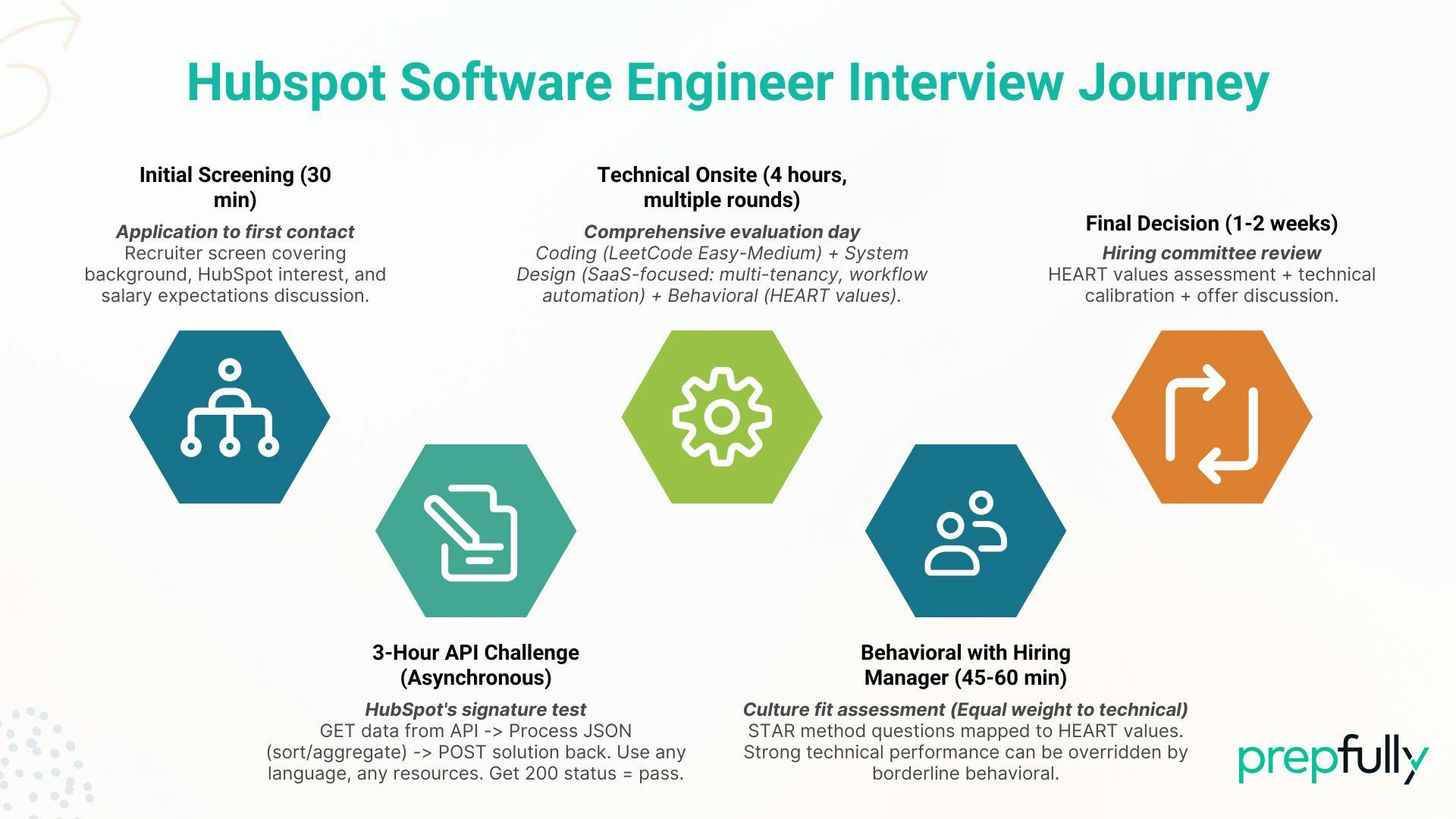
HubSpot interview stages: recruiter screen, 3-hour API challenge, 4-hour onsite (coding + system design + behavioral), hiring manager culture fit round, then offer decision within 1-2 weeks.
Round 1: Recruiter Screen (30 minutes)
Overview
Standard background check. The recruiter asks about your experience, why you're interested in HubSpot, and what you're looking for in your next role. They'll discuss salary expectations. Don't reveal specific numbers at this stage if you can avoid it, we've seen candidates who share ranges upfront often get bottled into these offer-time and on average end up starting at less attractive offers than those who push this conversation out to once they've proven their awesomeness
Round 2: The 3-Hour API Challenge
Overview
This is a reasonably unique part of Hubspot’s interview (which in full transparency we also really enjoyed researching deeply in conversations with our candidates and coaches, since it gets impressively close to how real work happens at companies) You'll receive an email with a link to start the assessment. Once you click it, you have exactly 3 hours to complete the challenge. But what makes it different from standard coding tests is that you're working with actual API endpoints.
The pattern is consistent across candidates:
- GET request to retrieve data specific to your user key
- Process that data (usually sorting or aggregating JSON arrays with fields like timestamps or enums)
- POST your solution back to a validation endpoint
- If you're correct, you get a 200 status code
You can use any programming language and any resources (Google, Stack Overflow, your own IDE). Most candidates on Prepfully report finishing in 2-2.5 hours, which gives you buffer time. After the 3-hour deadline, you can still clean up your code before submitting the final zip file, the timer applies to getting that 200 response, not to polishing.
One example from GitHub: "It's your first day at HubSpot, and you're in charge of writing logic to send invitations to a special two-day event in each country for HubSpot's partners. Find the dates with the most availability by processing partner survey responses, then POST back which date and attendee count for each country."
Something important from candidate debriefs: multiple engineers told Prepfully they don't think HubSpot deeply reviews the code itself, passing the assessment (getting that 200 status) seems to be what matters most.
HubSpot has an evaluation sheet. When they ask a question, they focus on specific aspects and ask you about those pieces one by one.
Round 3: Technical Onsite (4 hours)
Overview
The onsite consists of multiple 45-60 minute rounds with different HubSpot engineers. You'll face coding, system design, and behavioral assessments all in one day (or virtual session).
Coding Interview (60 minutes)
CoderPad or your own IDE shared via Zoom. HubSpot asks LeetCode Easy to Medium problems. Something worth knowing: they know these questions are available online. From the competitor blog and candidate reports, HubSpot interviewers acknowledge that questions can be found online and look for candidates who go deeper.
What they evaluate:
- Edge case identification (this is huge)
- Clear communication of your thought process
- Code quality and testing approach
- Optimization discussion and trade-offs
Common hubspot software engineer interview questions HubSpot candidates told Prepfully they encountered:
- Merge K Sorted Lists (LC 23, Hard but appears frequently)
- Meeting Rooms II (LC 253, Medium)
- Top K Frequent Elements (LC 347, Medium)
- Merge Sorted Array (LC 88, Easy)
- Two Sum (LC 1, Easy)
- Merge Two Sorted Lists (LC 21, Easy)
Difficulty breakdown: 30% Easy, 60% Medium, 10% Hard. The Hard problems typically show up for senior positions.
System Design (60-120 minutes)
The number of system design rounds depends on your level. Senior SWE 1 gets one round, Senior SWE 2 gets two.
For Senior SWE 1: You'll design something like Netflix (streaming with recommendations) or a weather service (sensor data collection and display). HubSpot's approach in system design is similar to other top companies. They expect you to cover good breadth and depth for the scope provided. It's extremely important to clarify the question and understand which dimensions your interviewer wants you to deepdive into, make verbal assumptions and validate them before going further.
One candidate on Prepfully put it this way: "They aren't as obsessed with you mapping out the most optimized solution. It's more about capturing a broad answer than going deep into one solution."
Key topics to cover:
- CDN architecture for content delivery
- Multi-region redundancy and failover
- Database design (when to use relational vs NoSQL)
- Caching strategies (Redis, CDN approaches)
- Load balancing and horizontal scaling
- API design and microservices patterns
For Senior SWE 2: Senior engineers have a more challenging process, since HubSpot adds a couple of additional steps to their loop. You'll first submit a written document about a technically challenging project from your past. The document should cover the business problem, technical challenges, your implementation decisions, design trade-offs, rollout plan, success metrics, and lessons learned. Then you'll have a live interview where 2+ senior engineers ask you questions about that project.
SaaS-Specific Considerations: Since HubSpot is a CRM platform, interviewers care about multi-tenancy architecture (how do you isolate customer data at scale?), API design for third-party integrations, and workflow automation systems. One candidate mentioned their interviewer asked about designing a reliable workflow execution system for marketing automation.
Behavioral Round (45-60 minutes)
The hiring manager conducts this round. You'll answer situational questions using the STAR method (Situation, Task, Action, Result), and interviewers map your responses to HubSpot's HEART values.
Behavioral assessment at HubSpot carries equal weight to technical performance. From a Prepfully debrief with a Hubspot coach, one candidate with "strong yes" ratings on both system design and coding still got rejected because the behavioral round was "borderline." The recruiter told them behavioral assessment matters as much as technical skills.
You cannot use notes during the behavioral interview (confirmed by multiple candidate reports on Reddit). Prepare your STAR stories in advance and memorize them.
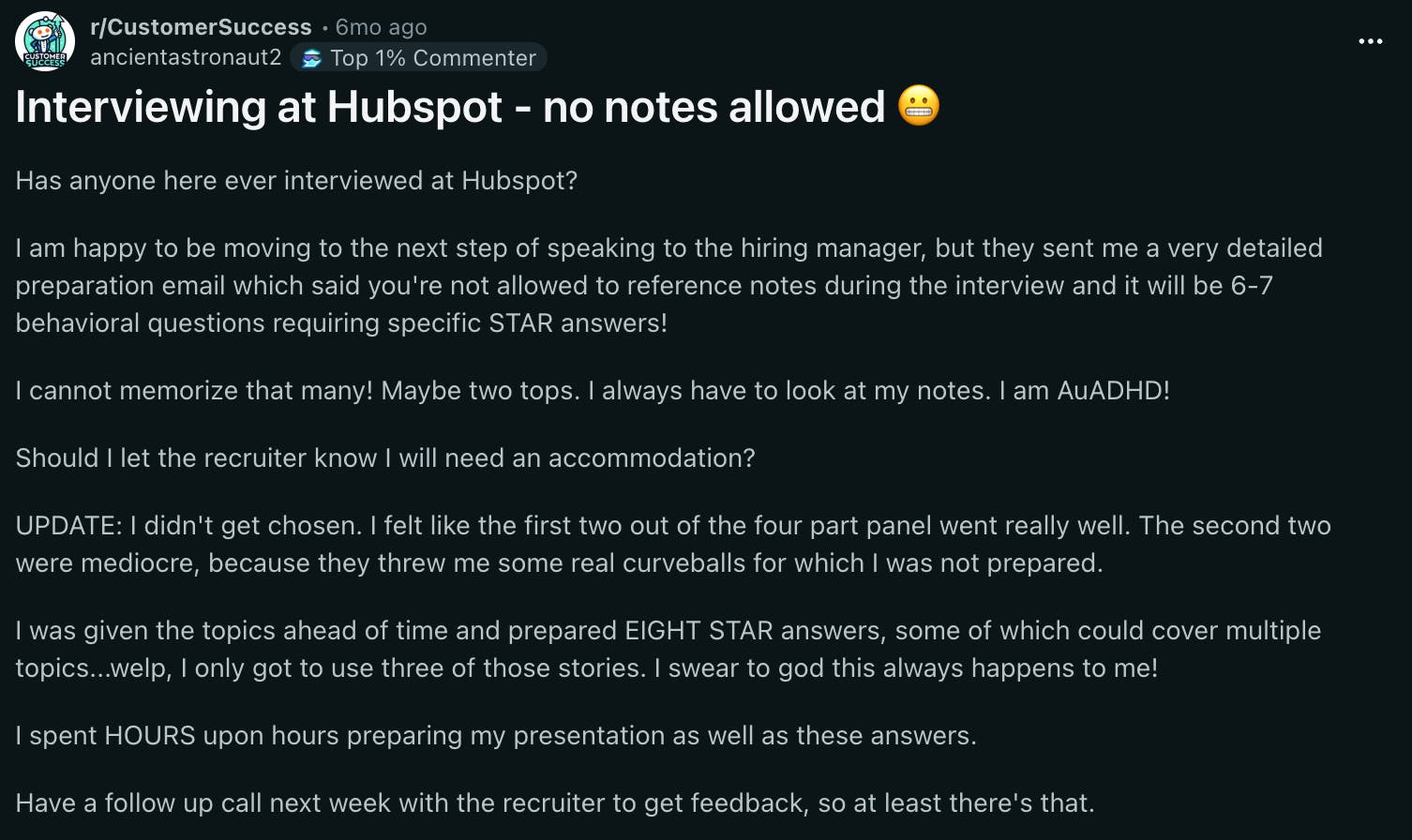
HubSpot explicitly prohibits referencing notes during behavioral interviews and requires 6-7 specific STAR-format answers, candidates report preparing 8+ stories but unpredictable questions mean you can't anticipate which you'll need (Source: Reddit)
Understanding HEART Values (This Matters)
HubSpot's HEART values can come across like standard corporate marketing fluff. However, from what we heard from HubSpot coaches on Prepfully, these can be particularly powerful to directly leverage in behavioral interviews. What each value means and why candidates get rejected for missing them:
Humble
What it means: Admitting when you don't know something, being open to feedback, and recognizing you're part of a team (not the hero).
Sample questions:
- "Tell me about a time you made a mistake. What did you learn?"
- "Describe a situation where you had to ask for help"
One of our candidates who unfortunately got rejected shared their experience on Reddit: they had 9+ years of experience but got rejected after calling an interviewer "really junior" and saying they "changed my direction to help her understand" their approach. This came across as condescending. HubSpot has strong cultural filters for ego, if you act superior to your interviewers, you're done.
Empathetic
What it means: Understanding customer pain points, supporting teammates through challenges, and putting yourself in others' shoes.
Sample questions:
- "Tell me about a time you had to support a struggling teammate"
- "Describe how you understood a customer's problem that wasn't obvious at first"
What works: Stories showing you can see multiple perspectives and collaborate across different viewpoints.
Adaptable
What it means: Thriving when things change, embracing new ideas, pivoting when your initial approach doesn't work.
This is one of the most valued traits at HubSpot according to internal sources. The research shows HubSpot values "people who can apply problem-solving skills across different types of work."
Sample questions:
- "Tell me about a time priorities shifted unexpectedly and how you handled it"
- "Describe a situation where you had to pivot your technical approach"
Remarkable
What it means: Going beyond what's expected, delivering exceptional work, taking initiative without being asked.
Sample questions:
- "Tell me about something you delivered that exceeded expectations"
- "Describe a time you went the extra mile for a customer or teammate"
Transparent
What it means: Clear, honest communication about challenges, trade-offs, and what you don't know.
Sample questions:
- "Tell me about a time you had to deliver difficult feedback"
- "Describe how you communicated a project failure to stakeholders"
Red Flags That Get You Rejected by Hubspot
A couple of things HubSpot coaches on Prepfully have warned candidates very strongly about avoiding:
Condescension toward interviewers: Showing you think less of an interviewer's technical level = immediate rejection, even with strong technical performance
Negativity about customers or colleagues: One candidate mentioned "so many annoying customers who couldn't make up their mind" and got a "hard no"
Vague, generic examples: Saying you "learned new technology" as a challenge doesn't count. You need specific, quantified stories.
Not knowing HubSpot's Culture Code: The document has 6+ million views and is publicly available. If you show up without reading it, that signals lack of genuine interest.
Practice with former HubSpot engineers on Prepfully to nail the API challenge and HEART values behavioral questions before your real interview.
→ Schedule NowIt's a good sign to say 'I don't actually know how we can do that' instead of mumbling for 10 minutes without meaningful explanation. What I'm looking for is hiring an engineer I want to work with.
How to Prepare for the HubSpot Software Engineer Interview
The 3-Hour API Challenge
This is unique to HubSpot, so your standard LeetCode practice won't cover it. What to focus on:
REST API practice: Get comfortable making GET and POST requests in your language of choice. Practice with any public API (GitHub, JSONPlaceholder, OpenWeather). To see how HubSpot engineers actually work with APIs at scale, Rishav Paul, William Hou, and Chris Connors explain how they built HubSpot's ChatGPT connector from scratch in weeks, their article reveals HubSpot's microservices patterns and the rapid iteration style interviewers expect.
JSON data processing: The pattern from candidate reports is always sorting or aggregating JSON arrays with timestamp fields or enum values. Practice parsing JSON, filtering based on conditions, and aggregating results.
Time management: You have 3 hours but most people finish in 2-2.5. Don't overthink the code quality, getting to that 200 status code matters most based on what candidates have shared.
Coding Round Prep
Focus on LeetCode Medium difficulty, especially HubSpot-tagged problems if you have LeetCode Premium. The company has about 240+ problems in their question bank. Practicing actual hubspot software engineer interview questions from recent candidates helps you understand the specific patterns HubSpot favors.
Key topics from candidate reports:
- Merge operations (arrays, linked lists, sorted lists)
- Hash maps and frequency counting
- Interval problems (meeting rooms)
- Heap/priority queue problems
- Array and string manipulation
What matters more than solving: edge case identification and communication. HubSpot knows you've seen these problems. They want to see how you think through boundary conditions and explain your approach. From candidate experiences, communication and asking clarifying questions are major evaluation factors.
This communication-heavy approach is similar to what you'll find at other top tech companies, the Meta Software Engineer interview and Google Software Engineer interview both emphasize explaining your reasoning over just producing working code
Practice explaining your thought process out loud. Run through test cases. Discuss optimization trade-offs even if your first solution works.
System Design Prep
Study these specific patterns since HubSpot is a SaaS company:
Workflow automation: How would you design a system that executes marketing workflows reliably (send email after 3 days, trigger action when user clicks)? Yash Tulsiani, a Technical Lead at HubSpot, walks through this exact type of problem when he debugged performance bottlenecks in HubSpot's import pipeline that processes millions of records daily using Kafka consumers, reading this gives you insight into how HubSpot engineers approach system-level problems.
Multi-tenancy architecture: How do you keep customer data isolated while running them on shared infrastructure? This comes up in almost every HubSpot system design interview.
Workflow automation: How would you design a system that executes marketing workflows reliably (send email after 3 days, trigger action when user clicks)?
API design for integrations: HubSpot integrates with thousands of third-party services. Think about API versioning, rate limiting, webhook reliability.
SaaS scalability: You need to scale from SMB customers to enterprise. What changes in your architecture?
Resources that helped HubSpot candidates on Prepfully:
- HubSpot Product & Engineering Blog (shows their actual technical challenges)
- Designing Data-Intensive Applications by Martin Kleppmann
- System design practice focusing on Netflix and weather service designs (these are HubSpot's most common questions)
Behavioral Prep
Prepare 8-10 STAR stories that cover all five HEART values. Some stories should map to multiple values, for example, disagreeing with your manager might show Humble (admitting you don't have all context), Transparent (being honest about concerns), and Remarkable (taking initiative to improve the situation).
You cannot use notes during the behavioral interview, so practice these stories out loud until you can deliver them naturally.
Study the HubSpot Culture Code. It's online, free, and has been viewed 6+ million times. If you show up without knowing HubSpot's values, interviewers notice.
Mock interviews make a difference. Several HubSpot candidates on Prepfully who got offers specifically mentioned that practicing with former HubSpot engineers helped them calibrate what "good enough" looks like for behavioral answers.
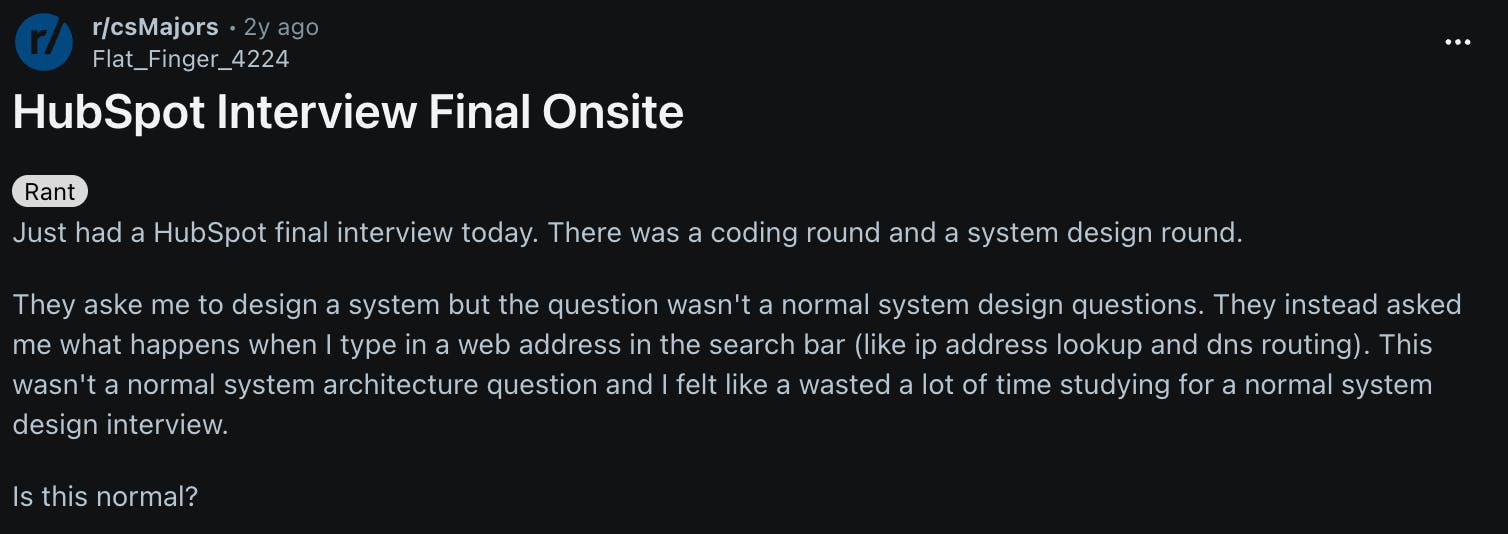
HubSpot's system design questions don't follow typical 'design Twitter' patterns, candidates report infrastructure fundamentals like 'explain what happens when you type a web address' catching them off-guard after preparing standard architecture patterns (Source: Reddit)
Compensation and Levels
HubSpot uses a fairly standard tech compensation structure: base salary, RSUs (restricted stock units), and annual bonuses. The equity is real, HubSpot is publicly traded (NASDAQ: HUBS), so your RSUs have liquidity.
Compensation by Level
Software Engineer (Entry-Level, 0-2 years):
- Total Compensation: $170K
- Base Salary: $148K
- Annual Stock: $18.8K
- Bonus: $3K
Senior Software Engineer I (L4 equivalent, 4-7 years):
- Total Compensation: $243K
- Base Salary: $193K
- Annual Stock: $48.7K
- Bonus: $515
Senior Software Engineer II (L5 equivalent, 8+ years):
- Total Compensation: $344K
- Base Salary: $235K
- Annual Stock: $108K
- Bonus: $179
Staff Software Engineer (L6 equivalent, 12+ years):
- Total Compensation: $365K
- Base Salary: $250K
- Annual Stock: $113K
- Bonus: $2.1K
Vesting Schedule
Entry-level roles: 3-year vesting with 33% in Year 1, 33% in Year 2, 33% in Year 3. 6-month cliff, meaning nothing vests until month 6.
Senior roles: 4-year vesting with 25% annually, also with a 6-month cliff.
Geographic Differences
Cambridge, MA (Headquarters): Highest compensation. This is where most engineering roles are based.
Dublin, Ireland: Senior Software Engineer I averages €135,647 total compensation (roughly $145K USD).
Remote US: HubSpot hires remotely for many positions. Compensation may be adjusted based on location but the company has embraced remote work (72% of employees work remotely according to 2024 data).
Negotiation
HubSpot compensation runs at roughly 50-60% of what Meta and Google pay at equivalent levels. The trade-off is a strong engineering culture, work-life balance, and meaningful SaaS product work.
The bonus amounts are modest compared to base and equity, so focus your negotiation energy on base salary and RSU grants. If you have competing offers from other tech companies, those can help, but the offer needs to be in writing and from a company HubSpot considers a peer.
The HubSpot SWE Interview tl;dr
What matters most if you're preparing for a hubspot software engineer interview:
The 3-hour API challenge is unique. Standard LeetCode grinding won't prepare you. Practice REST API calls and JSON data processing. Most candidates finish in 2-2.5 hours. Getting that 200 status code is what matters, code polish seems less important based on candidate reports.
HEART values carry equal weight to technical skills. This isn't like other companies where behavioral is a checkbox. Candidates with "strong yes" technical ratings get rejected for borderline behavioral performance. Prepare 8-10 STAR stories, study the Culture Code, and practice without notes.
They know the coding questions are online. HubSpot interviewers explicitly acknowledge this. What differentiates candidates is edge case identification, clear communication, and depth of understanding. Don't just solve, explain why your solution works and where it might break.
Behavioral can override technical performance. One candidate got "strong yes" on both coding and system design but was rejected because the behavioral round was "borderline." The hiring manager told them directly that behavioral assessment matters as much as technical chops.
System design is SaaS-focused, not pure scale. You need to think about multi-tenancy, API design for integrations, and workflow automation. HubSpot cares less about optimal solutions and more about broad architectural thinking and business context.
Interviewers are collaborative. Multiple candidates mentioned HubSpot interviewers being "friendly and collaborative compared to FAANG companies." They'll give hints and work with you, not against you.
Glassdoor is accurate for hubspot software engineer interview questions. Several candidates on Prepfully said Glassdoor gives a very accurate picture of what questions to expect.
Condescension kills your chances. A 9-year veteran got rejected for appearing condescending to a junior interviewer despite strong technical feedback. HubSpot has low tolerance for ego.
Ready to practice? Browse HubSpot Software Engineer coaches on Prepfully who can help you nail the API challenge and behavioral questions before your real interview.
→ Book NowRecently reported Hubspot Software Engineer interview questions
<div class='problem-card'><h3>Search for a Word in a 2D Board</h3><p>Search for a word in a 2D board of characters.</p><div class='example'><p><strong>Input:</strong> board = [["C","A","A"],["A","A","A"],["B","C","D"]], word = "AAB"</p><p><strong>Output:</strong> TRUE</p><p><strong>Explanation:</strong> DFS traverses adjacent matching letters perfectly, finding "AAB" without improperly revisiting any cells.</p></div></div>