
The Comprehensive Google Research Data Scientist Interview Guide
This interview guide covers the loop for Research Data Scientist candidates interviewing at Google. It's been written with the help of 3 Staff Data Scientists, a Lead Data Scientist, a Senior Data Scientist and a Product Data Scientist who have worked at Google. Thanks to candidates who are interviewing there in real-time, we've managed to keep this up-to-date with questions asked as recently as last month. This guide covers the full loop and lists recently reported questions for each round, including how Google runs the same 2 technical interviews twice, once in the first round and again in the final round.
The Google Research Data Scientist interview loop runs through these stages:
- Recruiter screen
- First round, 2 interviews:
Statistical Knowledge
Data Analysis & Intuition - Final round, 3 interviews:
The same 2 technical interviews again (Statistical Knowledge, and Data Analysis & Intuition)
Googleyness & Leadership
Statistical programming in Python or R, in one of the rounds above - Hiring committee review and team match
If you're interviewing as a Product Data Scientist, please switch to our Google Product Data Scientist interview guide.
Our coaches say PhD candidates generally land on Research and while they bring more coding and more statistics to the job, the day-to-day work is still product-heavy in itself.
Recruiter screen
This is a 30-minute call over the phone or on Meet with a recruiter to understand your work experience and get a first read on your level. They'll walk you through the interviews you'll sit and what each one covers.
The questions they'll ask are fairly straightforward:
- Walk me through your resume and point out the project you think is most relevant to Google.
- Tell me about a model or analysis you led that changed a product decision. What was your part in it?
- What's your timeline like? Are you currently interviewing anywhere else?
They'll most likely ask you about comp and what you're expecting but you're not obligated to name a number.
Your recruiter is your most valuable resource for anything specific to the role or the interviews. Ask them which round holds your statistical programming and lock in details like your coding language.
Google Research Data Scientist Onsite Interviews
Colloquially, the first and final rounds are referred to as the “onsite” and each interview lasts 45 minutes and is run by Google Data Scientists. Most loops run virtually but it’s possible that the final rounds are conducted in person at a Google office.
You’ll face:
- First round, 2 interviews:
Statistical Knowledge
Data Analysis & Intuition - Final round, 3 interviews:
The same 2 technical interviews again (Statistical Knowledge, and Data Analysis & Intuition)
Googleyness & Leadership - Statistical programming in Python or R, in one of the rounds above
Note: Some loops add an extra interview after the final round if one area of your feedback came back thin. If you’ve been told an extra round is scheduled, ask your recruiter for high-level feedback of your performance so far so you can anticipate what’s coming.
For the technical rounds, you’ll work in a shared doc that you can use as a scratchpad. The cases you’ll face in these interviews are product agnostic so you should be prepared to face questions about products that aren’t Google’s own.
Going by the insight gathered from our coaches during mocks, Google's case prompts are built around its heavy hitters that draw over a billion users or a billion dollars in revenue, so you should definitely be familiar with YouTube, Maps and Photos, and newer ones such as AI Overviews and Gemini.
Across the loop, your interviewers score you on 3 focus areas. Role-related knowledge (RRK) covers your grasp of the role and your past work, and the other 2 are Problem Solving and Leadership. Leadership at Google means emergent leadership, which is having the maturity to step up when the moment needs you and the restraint to step back when it doesn't.
1. Statistical Knowledge
This interview appears in both the first and the final round. It evaluates whether you can look at a scenario and pick the right method and if you know that method’s assumptions well enough to know its limits.
You’ll typically face a string of questions instead of one long case. The round progresses as a conversation with the interviewer where their questions will either build on what you said or introduce some kind of twist.
Expect a mix of academic questions and applied ones that have you use stats on problems Google has faced or on situations with no connection to tech. Our coaches say that probability comes up a little less than it used to and questions now lean toward experiment design or ML. The scope for ML doesn’t go past the fundamentals, but you'll be putting them to work on a scenario without writing a line of code.
You can count on a hypothesis testing question and one on linear or logistic regression showing up.
David Mease and Amir Najmi, Research data scientists at Google who have run over 600 interviews between them, have created a 10-question quiz based on the mistakes candidates make on these topics. They say that "Many of the wrong answer choices were motivated by incorrect statements made by candidates during actual interviews. Candidates making these 'red flag' statements generally went on to perform poorly overall in the interview later." All 10 questions and answers are in the post, and the average score is 7/10, so give it a shot before your interview.
Google still leans hard on ratio statistics, so expect ratio metrics like CTR and be ready to say which distribution sits behind each one.
As a senior candidate, you may be asked to explain a statistical concept in plain English to see how you communicate with non-technical stakeholders.
Prepare across these 2 tiers of topics:
- Basic concepts: probability theory (conditional probability, expectation, variance), hypothesis testing (such as binomial proportions), linear and logistic regression, resampling methods (bootstrap, cross-validation), predictive modeling, and statistical fundamentals, meaning the ability to communicate them clearly and concisely to non-technical stakeholders.
- Advanced concepts: Bayesian and related methods, clustering (supervised, unsupervised), time series analysis, experimental design, survival analysis, convex optimization, Monte Carlo methods and decision trees.
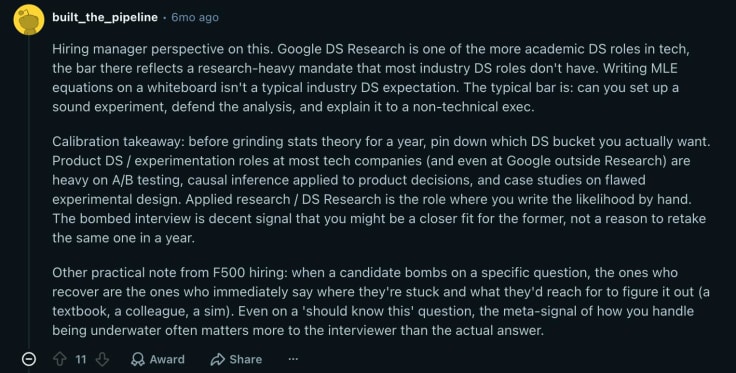
A hiring manager explains why Google Research DS has a more academic stats bar than most industry DS roles, Reddit, 2026
Interviewers and hiring managers who coach on our platform shared the questions that Research DS candidates are facing right now:
- A classifier catches 95% of truly fraudulent transactions and wrongly flags 2% of legitimate ones. 0.5% of all transactions are fraudulent. If a transaction is flagged, what's the probability that it's fraudulent?
- You ran an experiment and found a margin of error of +/-3. What would you change in the setup to bring it down to 0.3?
- You're running a trial for a drug against a placebo. You could give half the participants the drug and half the placebo. You could also give everyone the drug, wait for it to wear off and then give everyone the placebo. Which design would you pick, and why?
- Let's say the wait is long enough for the drug to wear off completely. Does that change your answer? - You have years of monthly forecast errors for an expense account. What's the standard error of the mean? How would you explain this to a business lead?
- What happens to the standard error if the monthly errors are autocorrelated?
- What if the errors have heavy tails, like a Cauchy distribution? - The ads team wants a regression model to predict how long a user spends on a website after clicking an ad. How would you build the model?
- You're working on Google's Pixel phones and need to build a feature that predicts battery life. How would you go about it?
If you want to cover more ground and come in a step ahead of other DS candidates, check out our data science interview course that’s created by senior DS leaders in the industry. It features 8 modules with proven frameworks and over 1000 practice questions you can practice with AI-powered feedback.
Answer the "how would you build it" question as a numbered pipeline, starting from data prep and ending with the model's assumptions. Interviewers pose such questions to see if you think about modeling as an end-to-end process. Letting you walk through the whole pipeline gives them a cleaner insight into your process because asking a bunch of questions might hint at what they’re looking for.
Whatever question you're answering, every technique you choose should come with a reason attached, and even offer to walk through how you'd apply it. Don't skip validation because you think it’s obvious (it is, but this is an interview after all).
2. Data Analysis & Intuition
This interview also appears in both the first and the final round. It evaluates how you scope a problem when you're given little to go on, and whether you can design a measurement that can answer a causal question, eventually reaching a recommendation.
The interviewer typically gives you a loosely specified business question (e.g. Users got 10% off everything on the Google Play store last weekend. Did the promo work?). You’ll have to set your course of action for the round by asking the right clarifying questions.
Sometimes candidates are shown a chart or a raw table and asked what looks healthy and what doesn’t.
The expectation is that in this round, you come up with a full analysis plan that covers opportunity sizing, experiment design, interpreting the results and the limits of the analysis.
These are the questions our coaches run in their own mock interviews to prepare candidates for a true feel of what their round will be like:
- Google Meet is testing a feature where users will receive AI-generated meeting summaries after a meeting ends. A PM is asking if this feature improves engagement or retention, and whether we can prove it's causal and not just correlated. What would you say to them?
- Could the summaries give people a reason to skip meetings? How would you account for that?
- The p-value is 0.07 and the PM says that's close enough to 0.05 so it’s okay to launch. What would you say to them?
- Some large clients will use this feature org-wide through an enterprise override so an A/B test can’t be run cleanly. What else can you do? - Assuming this is a new concept, how would you decide whether Google should build YouTube Premium?
- You're changing a button from blue to red and are expecting the CTR to go up from 14% to 18%. Let’s say the product gets ~1,000 impressions a day. How long would you run the experiment without needing the formula?
- A company recruits 1,000 students for a timed run. It gives the 100 fastest and the 100 slowest an energy drink they’re testing and then times them again. The slow group got faster, and the fast group got slower. Does the drink only help the slower runners?
- If you think the design of the experiment itself is flawed, how would you redesign it? - The VP of Google Workspace has 10 engineers to allocate to different teams. Should they go to Google Sheets or Google Docs? (asked of a Staff candidate)
- An engineer wants to launch a Gemini-driven search algorithm in Google Workspace that cuts search latency, but users have to sign up for it. The engineer emailed 10,000 users, and 5,000 signed up and got the new algorithm. Their latency is 120 ms against 130 ms for the users who didn't sign up. Would you recommend launching it for everyone?
See the full list of questions for this interview in our free Google Data Scientist interview question bank that's built by vetted reports from candidates and interviewers.
Our coaches have 3 tips for this round:
- Choose a primary metric that’s narrow and time-boxed. If you pick a broad one like engagement that can move because of seasonality or marketing campaigns, the interviewer will bring up each of these to test if your metric can be attributed to the feature and that’s a lot of unnecessary tangents.
- Don’t bring up CUPED when the PM is asking whether the feature can be launched. It’s a good way of making the next experiment more sensitive but it’s answering a completely different question.
- Interrupted time series, propensity score matching, regression discontinuity and diff-in-diff are the standard toolkit when A/B testing isn’t possible. If you choose diff-in-diff, the interviewer will almost immediately ask you how you would check for parallel trends. If you mention synthetic control, they will ask you how you would build the donor pool, so only mention it if you are able to explain it in such detail.
A lot of Google's features only activate when a user takes a particular action, so only a portion of your treatment group will ever see the change. Obviously, you’ll measure the lift on the users who did trigger it but you should also then calculate what that lift looks like when it is spread across the entire treatment arm, including the users who never triggered it. The number will be smaller, but it matters to the launch because the feature will be released to everyone.
This round is a major leveling signal between L4 and L5 candidates. One of our coaches who ran over 90 DS interviews at Google says it comes down to how deep your quasi-experimental answers go. It would be utopian for this guide to be able to tell you how to come across as an L5, but only someone pushing the limits of your answer can do that for you. That's exactly what we built our platform around. A 1:1 session with a coach who can tell you the level at which your answers are landing right now and coach you to reach the level you’re gunning for. Nobody better than Google’s own interviewers to do that for you.
Let us match you with an expert or book directly with a Google DS interview coach of your preference
3. Statistical programming
This portion shows up in one of your rounds and your recruiter tells you which one well in advance. This is the Python or R part of the loop where you’ll read and fix statistical code in a shared doc without running it. The round evaluates your ability to read a piece of analysis code and understand what it is meant to do, and spot any nuanced issues that would result in a wrong number (instead of a flat-out error). You may also be asked to write statistical code of your own.
A typical question is a function of about 20 lines, such as a train/test split, with something missing. You won’t face any LeetCode-style problems or heavy algorithms here because the focus is advanced statistical coding and modeling.
One of our coaches says that this part of the loop has been recently reworked around AI-written code so you should be prepared to review and talk through fixes and optimization for a block of code that Gemini (probably) wrote.
Expect questions like:
- You said you’d use that estimator. What’s its variance? Code it.
- Come up with a process to fill in the missing values in this dataset.
- Check if this pandas function that takes a table of timestamps and user IDs and computes DAU and its daily percent change does its job.
- Which events should count as active?
Generally speaking, one of our coaches recommends that you pick Python with pandas if you’re choosing a language, because that’s what Google’s data scientists use day to day.
4. Googleyness & Leadership (G&L)
This interview only appears in the final round where you’ll face behavioral and hypothetical questions. In a deeper sense, the round evaluates whether you can get cross-functional partners to work with you and trust your analysis and whether the scope of your stories matches the level you're interviewing for.
The questions and their follow-ups evaluate your communication, time management, decision making, flexibility, initiative, leadership, organization, and problem solving.
Googleyness is a set of traits, both personal and professional, that Google uses to evaluate candidates. If this is your first time hearing about this word, you’d benefit greatly from our article that breaks down the traits with advice on how you can effectively convey “Googleyness” in your response.
Expect questions like:
- What do you do if someone from a different org challenges your approach?
- Tell me about a time you used data to clarify something when everybody else was working off instincts.
- What would you do if you recommended against a launch but the team went ahead anyway?
- How do you keep your xfn partners (SWEs, PMs, etc) accountable for all their deliverables when you’re working on a project?
- What if your lead asks for an estimate by EOD on something that would take at least a week? What would you do?
Especially with regard to hypothetical questions, our coaches suggest that you draw an immediate parallel to a real-life scenario that’s very similar to the question and detail what you did.
In this round, you need to land on the right story quickly and recollect details without dragging out your story. The best way to do that is to write a story bank of 6-8 stories before the loop and practice their delivery. A set like this covers 80-90% of the questions you’ll get.
We recommend that you take the classic STAR framework and build it out into STAR+ (Situation, Task, Action, Result + the X-Factor: Learning) to structure your stories. You end each story with a personal takeaway and how it changed the way you work. This way, you’ll demonstrate intellectual humility which implicitly links to traits of Googleyness.
Hiring committee, team match and offer
The Hiring Committee will receive a packet that contains every interviewer’s rating of your performance from Strong Hire to Strong No Hire. This committee consists of 4-5 seniors pooled from unrelated teams and they’ll review and decide if you should move on to the Team Match phase.
Our coaches say they’ve written feedback in packets recommending that a stats-heavy candidate with weak product intuition be tried on the Research track.
Google Data Scientist Total Compensation (USD)
- L3, Data Scientist II: $194.7K
- L4, Data Scientist III: $280K
- L5, Senior Data Scientist: $379.2K
- L6, Staff Data Scientist: $490.7K
Comp reaches $1.01M at L8.
Recently reported Google Data Scientist interview questions
Identify one critical flaw in a major Google product and describe the data-driven feature evolution you would lead to fix it.
Product Sense
Write the implementation for a deduplication algorithm applied to a live message queue, versus deduplicating a petabyte-scale historical data warehouse.
Coding, DS Technical Skills
Describe a technical obstacle you encountered recently. How did you methodically overcome it?
Behavioral, Problem Solving
Frequently Asked Questions
Most Google behavioral interviews test stakeholder management; these guides provide essential context on those partner roles.
- The Ultimate Google Product Data Scientist Interview Guide
- The Google Site Reliability Engineer Interview Guide
- Google Account Manager Interview Guide
- Google UX Researcher Interview Guide
- Google Product Manager Interview Guide
- Google Software Engineer Interview Guide
- Google Technical Program Manager Interview
- Google's Googleyness Interview
- Google Data Analyst Interview Guide
We've seen (through mock interview and advice booking patterns) that candidates interviewing for Data Scientist roles often have interviews lined up at multiple companies in parallel. For clarity: we also strongly recommend trying to achieve this proactively, since in a challenging market like we're currently in, the most effective way to negotiate salaries is to have a competing offer *at the same time* as you receive an offer from Google. The most common guides that candidates interviewing for DS roles tend to visit are listed below.
- Visa Data Scientist Interview Guide
- The Ultimate Google Product Data Scientist Interview Guide
- Shopify Data Scientist Interview Guide
- Amazon Data Scientist Interview Guide
- Meta Data Scientist Product Analytics Interview Guide
- Pinterest Data Scientist Interview Guide
- Instacart Data Scientist Interview Guide
- Uber Data Scientist Interview Guide
- Meta Data Scientist Interview guide
We regularly update this guide to ensure accuracy. Here's our recent update history:
November 2026
- Published Google Research Data Scientist guide