
Visa Data Scientist Interview Guide
This guide covers the interview loop for Data Scientist candidates interviewing at Visa. It incorporates comments from over 5 senior data scientists who’ve worked at Visa, recent reports from Visa DS candidates, and insight from 14 transcripts (with approval from candidates and coaches, of course). We’ve covered the core structure for each round (including changes made to the loop in 2026), and made sure to include interview questions from as recently as last week.
TL;DR the Visa data scientist interview loop looks like:
Step 1: Recruiter screen
Step 2: Online Assessment
Step 3: Superday
- 3.1 Behavioral
- 3.2 Business Acumen
- 3.3 Stats & experimental design
- 3.4 Machine learning
Every time someone taps a card, Visa runs a small calculation. Multiply that by the 258 billion transactions (in 2025) reported by Visa and you get a sense of the scale the data science team works with.
Data Science (DS) teams at Visa are run agile with end-to-end ownership. The interview for the role is designed to test whether you can start with raw data and end with a business recommendation, often directly to clients.
In this guide, we cover the entire interview loop for data scientists at Visa.
What you’ll be tested most on will vary by the team you’re gunning for.
Visa’s consulting and analytics (VCA) arm will have a heavy emphasis on testing your ‘business acumen’. VCA roles are also client-facing so expect the cases to be built around their clients’ problems. So overall, expect more cases and less coding, and a much greater expectation to understand the industry and speak their vocabulary.
Visa’s Technology arm or teams like Global Risk care more about the engineering parts, so expect a bigger focus on ML and experimentation. Typically questions will focus on modeling and monitoring their fraud pipelines.
You want to find out what your target team works on before you start prepping. Try to understand their daily problems and the tech stack they work with. You can pick up the unwritten details from a veteran Visa Data Scientist through Prepfully.
What does the Visa Data Scientist interview process look like
The entire interview loop has three stages. The Superday stage will be the largest with three to four interviews back to back.
Round | What are Visa interviewers assessing? |
|---|---|
Recruiter Screen · 30–45 mins | Does your work background fit the demands of the role? Are you a good communicator? Why do you want to work at Visa? |
Online Assessment · 40–90 mins | Can you work and code well under pressure? How do you handle messy data? Can you connect technical or ML problems to the business context? |
Superday · 4 back-to-back interviews · Half a day | Will you get along with the team? Can you get people to listen to you and back your ideas, even if you aren't the boss? Can you make independent decisions without hand-holding? Do you understand the payments industry and what Visa does? Do you have the statistical chops to work on data at Visa’s scale? Can you break down the complicated stuff into simple terms for clients? |
Note this down if you're a new-grad: The interview process for you will include a HireVue game assessment and also some group and individual case exercises. The questions will be similar or simpler than the ones described in this guide.
Some example questions for Visa’s grad candidates:
- Given a set of jars and a sequence of range-based operations, determine the final number of jellybeans in each jar after all operations are performed.
- Given an integer N and an array a[], find the number of index pairs (i, j) such that a[i] - a[j] = N and i > j.
- Given the number of nodes and the number of edges connecting these nodes, arrange these edges so that the max possible number of nodes are strongly connected.
Learn Visa’s vocabulary before your onsite
Senior Visa employees who coach on Prepfully say you have to learn Visa's vocabulary before the Visa onsite. Now, for most (barring some senior roles) candidates, interviewers know and understand you might not have the industry-experience and knowledge. But they will expect you to care about what the company does and it goes over well if you’ve looked these terms up before your interview.
Here’s a 101 on the industry terms:
Issuer: The bank which provided the credit card to the holder (e.g. Chase). The final decision to approve or decline a transaction is given by the issuer.
Acquirer: The bank that processes payments on the behalf of the merchant. Make sure you understand the difference between acquirers and issuers, and the part each plays in a transaction.
Authorization rate: The percentage of total requests that the issuer approves. Auth rate is a measure of the network's health, so you might be asked to diagnose an auth rate drop for a specific scenario.
Approval rate: The percentage of unique customer checkouts that successfully end in a sale. The approval rate is the primary pulse check for what the merchant aka Visa’s clients care about. Sometimes used interchangeably with authorization rate, but technically they’re not the same thing.
Card-not-present (CNP) fraud: This is fraud that happens without the physical card itself so usually on online purchases or phone orders. CNP fraud is a big focus for Visa's fraud teams as it's much harder to detect and higher risk than card-present fraud. The ML round case is often based around CNP so think about why these kinds of transactions are harder to deal with.
Interchange: The fee (usually set by Visa) the acquirer pays to the issuer per transaction. Interchanges come up frequently in case rounds.
Chargeback: A forced reversal of the transaction that’s initiated by the bank on behalf of the cardholder. If a merchant’s chargeback rate is high, it can mean potential fraud or other problems.
3D Secure (3DS): A protocol that adds an extra security layer to prevent fraud, but it can also add friction in the transaction and end up reducing conversions. This tradeoff between catching more fraud vs. suffering lower approval rates is the kind of stuff Visa interviewers will want their DS candidates to reason through.
VisaNet: The main payments network behind Visa which processes 258 billion transactions yearly over almost 5 billion cards.
We recommend you read a few consulting cases on Visa's site before your Superday. It’ll help you reframe problems and understand the important aspects of a case.
Recruiter screen
Fairly standard recruiter screen, about 30 to 45 mins long covering your background, what you've worked on, why you want the role, why Visa, and when you're available.
For this round, Visa recruiters are looking at:
- Your past project experience and if it ties to Visa’s work.
- Background and culture fit mapped to Visa’s leadership principles.
You might be asked questions like:
- Introduce yourself. Why do you want to join us?
- What are your goals?
- Help me understand your skillset.
- Can you walk me through your projects?
We suggest you prepare a short intro about yourself and your projects that ties in with what the team at Visa is solving. And, for the ’Why Visa’ question, a generic answer will end up in you being too forgettable as a candidate, so we have a straightforward suggestion: be specific and tie your answer to something related to payments, fraud detection, the Visa Protect suite, or VisaNet’s scale.
Online assessment
The Visa OA typically involves transaction records, merchant tables, cardholder data, authorization logs, and the platform will vary by team. You could be given a HackerRank test or a CodeSignal GCA.
It should take between 40 to 90 mins; the time will be split equally between 3 sections: 1. Python, 2. SQL, 3. ML modelling.
What you’re being scored on: How strong your fundamental DS skills are, and if your coding skills pass their baseline.
Things you might be asked in this round as reported by Visa candidates:
- For SQL: Queries on transaction-style schemas involving stuff like multi-table joins, window functions (RANK, DENSE_RANK, LAG, ROW_NUMBER), aggregations with NULLs and deduplication, derived metrics.
- For Python/pandas: You should expect operations involving groupby, merge, filter, rank. Some candidates also reported basic algo problems such as a Fibonacci sequence. These won’t be hard, but writing cleanly under a timer takes practice.
- For ML concepts: Basic concepts like model selection, what to do if linear regression assumptions are broken, A/B testing, and conditional probability questions.
Since this can feel like you’re in crunch time, we recommend IDing the simplest correct approach, writing it, and moving on. That’s it, don't try to optimize for no reason. To practice for this round, check out our free Visa DS interview question bank.
Superday
The Superday is 4 back-to-back interviews which cover behavioral, business cases, stats/experimental design, and machine learning. Each round should be around 45 mins. The interviewers will usually be senior data scientists or even Visa directors (for case rounds).
There is some slight variation in the rounds depending on your team. For some candidates the two technical rounds were combined into one. VCA candidates in particular could get another consulting or behavioral interview which will focus on client relations and communicating with non-technical people. A Visa employee on Fishbowl shared that the business acumen case round and the technical will be tough while the others are ‘pretty easy’.
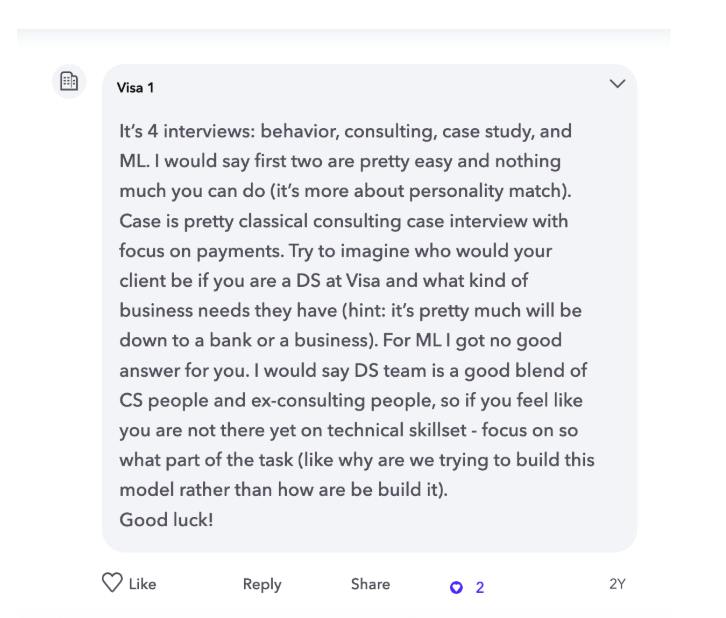
A Visa employee on Fishbowl breaks down the DS interview loop.
We’ve heard reports from candidates that the Superday had no live coding and all rounds were whiteboard or conversational based. Expect a lot of tradeoff questions and a big focus on communicating to non-technical people.
There are four Visa leadership principles. Before the Superday, you want at least one STAR story mapped to each principle. While you’ll be tested on them directly in the behavioral round, interviewers across all four rounds of the Superday are looking for high-level cultural fit.
What makes a good STAR story @ Visa?
- Situations where you, extra emphasis on you, influenced a decision. To show off your communication ability, you can talk about a time where the stakeholders initially disagreed with you in some way, and you then brought them around.
- Hard concrete numbers. "Approval rate went up 13% the following quarter" > "everyone was happy".
- Try connecting your stories to the payment or fraud domain in some way. Even if you don't have any projects involving those aspects, you can talk about a common system or protocol that you know is important for Visa as well.
The 4 leadership principles, and what Visa wants in their data scientists:
- Lead Courageously: Visa wants you to act like an owner, think big, and hold yourself and others accountable. If you find something that challenges you, how do you deal with it?
- Obsess About Customers: Can you keep in mind and connect your decisions for the people on the other end of the transaction? Can you explain your past work in terms of what it did for a customer? So it’s vital you discuss your projects in terms of the positive change it brought users.
- Collaborate as One Visa: There’s three parts to this one. Do you enable the people around you to do better work? Do you encourage debate as a team leader and make room for people who see the problem differently than you? Do you champion inclusion and diversity?
- Execute with Excellence: Visa wants people who see things through to the end. Did you learn from your efforts and iterate? What happened after you released a model? What did not work? What would you do differently a second time around?
If you’d like a sense-check of your stories and delivery, we recommend practicing with a Visa data science coach.
Behavioral round
This round will be based explicitly on Visa's leadership principles. Visa wants to understand how you operate in a matrixed org where everyone has a seat at the table and doesn't always agree with what the model says.
Other than the leadership principles, interviewers are also scoring you on:
- Individuality and personal purpose. Visa wants to see you offer your own viewpoint, and push back on decisions even if it’s uncomfortable.
- Leadership experience to make sure you can manage and influence the decisions of various stakeholders.
Visa DS candidates have been asked these questions:
- Tell me your life story.
- How would you describe yourself and why do you think we should hire you?
- Is there anything you would change about Visa?
- Have you ever had to deliver a result the stakeholder didn't want to hear?
- Tell me about a project that didn't go as planned.
Business acumen round
Think of this round as a Visa consulting case you have to solve. The discussion will be led by the interviewer and you’ll be asked to work through some calculations as the case evolves.
The focus will also be on your technical knowledge of the payments system.
Visa DS candidates have reported these questions:
- You are a DS for a telecom company. Can you figure out which customers will buy an international roaming pack in the next three months?
- What kind of metrics would you choose to measure if a new cardholder rewards program is successful?
- A merchant's approval rate dropped 15% over two weeks. How do you diagnose it?
Prepfully coaches recommend you keep in mind your clients’ business needs when working through the case. Interviewers want to see how you think through and break down a business problem. You should also be able to make back-of-the-envelope calculations super quickly. For these questions, it can be helpful to know the exact formulas but the interviewers care much more and want to know if you understand the business logic behind the math.
Keep in mind that the business acumen round is also a personality check. Would you make for a good colleague? Have you researched Visa’s world and know some of the industry lingo? This is because at Visa you might be working directly with the client as a consultant, so one of our coaches talks about how to approach the case keeping in mind the client ultimately cares about the answer:
Those people like to hear the answers first. So what I would recommend is you still start with the problem. You say for instance in this case, sales have been declining. We found that the reason is most likely the declining market share for millennials in the past three years. And to help with that, we recommend X. And then after that you say, looking back at the data, we found millennials declining, Gen X semi-holding, boomers we're killing it. So just finish the answer or the recommendation first. And then after that you can discuss the data, because more likely they don't care that much about the data.
Technical 1 - Stats & experimental design
On the face of it, this is a stats round, but don't think of it purely in that way. Most questions will be framed around business decisions. Interviewers want to see if you have solid footing on basic statistical concepts, and understand the theory at a higher level. They also expect you to design and critique experiment setups.
Recently reported questions from this round as reported by Visa candidates:
- How would you create a system that detects anomalies in a user's server data and sends alerts to get the user's attention?
- Can you walk me through the process you use to choose the perfect statistical test for a problem?
- What calculation would you perform to find the probability of accurately guessing a randomly selected card from a deck?
- Could you figure out the odds of getting heads twice in a row in a coin toss?
- How would you design an A/B test for a new fraud alert feature? Walk me through your setup, sample size calculation, and success criteria
Technical 2 - Machine learning round
The questions you get in this round will likely be based on the algorithms you’ve listed on your resume.
Recent candidate reported questions from this round:
- What's your strategy for dealing with high-dimensional datasets in a machine learning problem?
- What are the difficulties faced when you have a model with a lot of layers?
- Can you explain the learning rate for XGBoost?
- Are you well-versed in XGBoosting and the various hyperparameters that can be fine-tuned for optimal performance?
- Design a model to flag fraudulent card-not-present transactions. What features would you use and what would you optimize for? How would you monitor it in prod?
Pay special attention to XGBoost and SMOTE since they’re commonly used for fraud detection, even if you haven’t built projects using those algorithms.
Make sure you don't exaggerate your project work and understand the reasons behind everything you’ve put on there. One candidate mistakenly claimed they’d used logistic regression on a 500-feature dataset, which the interviewer pointed out was not a good idea at once.
Also expect to get an end-to-end ML case. The scenario will usually be related to fraud or risk management. That means you have to start by framing and breaking down the problem along with the goal, and end with how you'll put the model to work.
If you want to sharpen your answers around what Visa (and other) interviewers expect, check out Prepfully's data science interview course.
How your performance is judged this round:
- Your understanding of algorithms, and if you’ve thought through your projects in detail.
- Visa interviewers want to see if you can explain trade-offs you had to make at different steps of your project, and map out potential problems you might run into.
- Interviewers care whether you've thought about what happens after the model ships. You should be able to discuss choices made during deployment, and what you’d monitor post-deployment.
Monitoring is super important since Visa runs models that score billions of transactions in real time and even minute drifts can cause big problems. This round shares a ton of DNA with the case study portion of the PayPal DS loop.
TL;DR this is what it takes to pass Visa’s Data Science loop
The Visa DS interview is broad by design. You’ll be tested on SQL, ML, experiment design, business cases, and behavioral in one day. That’s a lot of stuff to study, but it’s also a big opportunity to stand out. Visa is hiring for people who’re technically excellent and understand the global systems that move money.
In this context, given how important it is to stand out from other candidates, we strongly recommend that you learn Visa’s world and vocabulary. When you solve a case, you want to connect it with Visa's business problems so that you can tie them back to the specific domains you’re interviewing for. This is almost a shortcut to being remembered among a large pool of qualified candidates.
If you want to test your prep under real conditions, and sanity check if you’re meeting Visa’s hiring bar for DS candidates, book a mock session with a Visa Data Scientist coach on Prepfully.
What’s the total compensation for a Visa Data Scientist?
Levels.fyi data from May 2026 shows total comp starts at $156K (base $137K) at L3 and $340K (base $265K) at L7.
Note on L8:The DS track reliably tops out at L7 in most Levels.fyi submissions. L8 figures vary across sources and even a couple of new submissions will shift the averages.
Candidates report a 3-year vesting schedule. Often, it's an equal 33% split across all 3 years, though splits vary. Some candidates report the split being 20% in year one, 20% in year two, and 60% in year three.
Recently reported Visa Data Scientist interview questions
Summarize what these visuals are telling us. After that, outline the exact data transformations needed to build cohort charts that reveal the root cause of the drops.
DS Analytical Execution, Product Interpretation
Detail the operational metric tree you'd use to diagnose a sudden 5% drop in weekly active users on a messaging platform.
Metrics and Experimentation, Product Sense
How do Lasso and Ridge differ in their mathematical behavior?
Machine Learning, ML Knowledge
Frequently Asked Questions
No, Visa interviews and accepts candidates from all sorts of industries, and actively welcomes different backgrounds. You should still learn the industry vocabulary before your onsite though. It shows your interviewers you’ve done your homework and you care about the job. Plus, you’ll probably be given industry-specific cases so it helps to know the basic concepts and terms.
Overall, the interview is not entirely domain-specific since Visa accepts people with zero experience in the industry. But for the case study rounds, you’ll be expected to know standard industry terms and have 101 knowledge of transactions.
Visa recruiters will ask DS candidates about their experience and career background. Expect standard questions like “Why Visa?”.
The Visa DS Superday is 4 back-to-back interviews which cover behavioral, business acumen, experimental design, and ML. The exact order and breakdown will vary by the team, and your interviewers will usually be senior data scientists or directors at Visa (for the case rounds).
According to (April 2026) data from Levels.fyi, Visa pays between $156K at L3 and $340K at L7.
To excel in your Visa interview, explore these guides to understand how your role interfaces with other departments.
We've seen that Data Scientist candidates who manage parallel interview loops have much better salary negotiation outcomes at Visa, so here are the guides they study.
- The Ultimate Google Product Data Scientist Interview Guide
- The Comprehensive Google Research Data Scientist Interview Guide
- Shopify Data Scientist Interview Guide
- Amazon Data Scientist Interview Guide
- Meta Data Scientist Product Analytics Interview Guide
- Pinterest Data Scientist Interview Guide
- Instacart Data Scientist Interview Guide
- Uber Data Scientist Interview Guide
- Meta Data Scientist Interview guide
We regularly update this guide to ensure accuracy. Here's our recent update history:
Nov 2024:
- New guide created for Visa Data Scientist interview process covering the end-to-end hiring loop