
The Comprehensive Tesla Product Manager Interview Guide
This interview guide covers the loop for Product Manager candidates interviewing at Tesla. It's been written with the help of 4 Senior Product Managers who have worked at Tesla. Thanks to candidates who are interviewing there in real-time, we've managed to keep this up-to-date with questions asked as recently as last month. This guide covers the full loop and lists recently reported questions for each round asked in 2026.
The Tesla PM interview loop typically goes through these stages:
- Application screen
- Recruiter phone screen
- Hiring manager screen
- Team or case interview (loop dependent)
- Technical interview (mostly for technical PM roles)
- Take-home case (loop dependent)
- Onsite/Panel day: a presentation and 3-6 1:1s of
Product Sense and Prioritization
Product Analysis and Metrics
Working with Engineering
Cross-functional Leadership
Ownership - Evidence of Excellence and executive approval
- Offer and compensation
Knowing which org/team you’re interviewing for is pretty much the first step of prep because Tesla hires PMs into a specific team's opening. You have to meet (or exceed) the hiring team’s expectations from day one.
Recruiter phone screen
This is a 30 minute call with a recruiter to understand your work experience and get a first read on your level. They'll walk you through the interviews you'll sit and what each one covers.
The questions they'll ask are fairly straightforward:
- Why Tesla?
- Walk me through a product you've worked on in detail.
- Which Tesla team or product are you most excited to work on?
- Tell me about a product you've owned end-to-end. What kind of revenue impact did you drive?
- What's your timeline like? Are you currently interviewing anywhere else?
We'd suggest putting together a career highlight summary of about 2 minutes and practicing it until it sounds conversational, so even if you feel like you’ve been put on the spot, you won't forget the important details.
When you're (inevitably) asked why Tesla, have an answer that’s tied to the team's product and how it relates to the work you've done. We strongly suggest you avoid a generic answer about innovation or EVs that could come across as bland/template.
Hiring manager screen
This is a 30-60 minute video call with the manager you'd report to, and your performance here decides whether you move on to the panel/onsite interviews. The manager will usually start with standard questions about your background and how your work maps to the role. Once they brief you about their team's own domain, they’ll get into technical/domain-specific questions that'll keep coming till they can see the edge of what you know.
One candidate said that their HM turned most of the call into what-if product cases built on their resume projects and ended with a few behavioral questions.
Candidates have reported facing questions like:
- Tell me about the best product or project you've worked on. What were the metrics that told you it was working?
- Suppose this project on your resume had to be delivered in half the time. What would change?
- Tesla doesn't do traditional marketing, so how does that change what you'd build into the product?
Team or case interview
Some loops slot in a 30 minute interview with someone from the team between the hiring manager screen and the panel (a Senior PM candidate had theirs with a Staff-level team member), and a few loops have two of these. It goes one of two ways:
- Case interview: You're handed a product case with some light behavioral questions around it. For example, you may be asked to walk through how you’d approach a novel product release at a high level, without any technical questions.
- Whiteboard session: You work through a product case with PMs from the team. In one of these, the interviewer opened with a product design question and then asked execution questions on that same design, so the second half was all about shipping what had just been designed.
Either way, the case runs much like the Product Sense and Prioritization round on the panel day, so we’ve covered how you should approach such questions in detail there.
Candidates have reported prompts like:
- How would you oversee the release of a new feature that shows Tesla owners analytics about their driving?
- Design a podcast product for Instagram.
- How would you improve the Tesla app for someone picking up their first car?
- Pick a Tesla product you know well. What's its biggest weakness, and what would you do about it?
Technical interview
This interview mostly shows up for software and technical PM candidates interviewing for teams like cell software and manufacturing systems. You may face this round before or during the 1:1s of the onsite. We’ve covered it in detail in our “Working with Engineering” section of this guide.
Candidates have reported facing questions like:
- How do you prioritize features for your engineering team?
- How do you weigh tech debt against new features?
- Walk me through the tables you'd need to track a car from order to delivery, and how you'd query them to find where deliveries get stuck.
Take-home case
Some loops include a take-home assignment that connects back to the rest of the loop by becoming a 30 minute presentation that you’ll have to give at the onsite.
The assignment, depending on the team, can be:
- a case the team sets
- your choice of a specific product you've worked on
The goal of this exercise is to see how you approach an unfamiliar problem and sketch everything out from product design to strategy.
Prepfully candidates who recently appeared for the panel reported the following prompts:
- Redesign an airport layover.
- Do a market analysis of the EV market.
- Pick a market where Tesla doesn't sell Powerwall yet. Should it launch there, and what does the first version look like?
You'll obviously use AI to research and work efficiently but we suggest you take the effort to write the copy of the presentation yourself. AI has just not evolved to the point to which it’s completely indistinguishable from human effort so if the panel receives a deck inundated with AI-isms, it’ll leave a bad taste. Most candidates are asked to submit their deck a day or two before the presentation, which gives the panel plenty of time to read every slide in detail before you appear.
The Tesla PM panel/onsite interviews
The panel is the final round. It kicks off with a presentation of about 30 minutes to everyone on the panel, after which each panelist takes you for a 30 minute 1:1, back to back. Expect anywhere between 3-6 of these that typically cover:
- Product Sense and Prioritization
- Product Analysis and Metrics
- Working with Engineering
- Cross-functional Leadership
- Ownership
The panelists come from across the team you'd join. Candidates report PMs, staff engineers, product designers, engineering managers, directors and business stakeholders as interviewers.
1. Presentation
The presentation tests whether you can make a product case and then defend every call in it when different people with different domain strengths pick at a different part of it.
You'll present for roughly 20-30 minutes and the panel may interject with questions or new information as you go. The discussion doesn't necessarily follow the order of your deck so you should be prepared to defend each point in your deck in an instant.
The panel will challenge your trade-offs and the points you've made and will expect that you defend them without becoming rigid or defensive. Then again, you shouldn't immediately drop a suggestion you've made simply because someone senior has disagreed.
Generally speaking, you should leave out any confidential details of the project you’re presenting. It may add weight or oomph to the point you’re making but in the bigger picture, the interviewers may interpret it as a sign that you can't be trusted with Tesla's own work.
If you'd like a Tesla PM interviewer's opinion on your take-home or presentation before you appear for the onsite, you can get in touch with one here. They'll also give you a heads-up on the kind of questions your panel will come with and the kind of answers they’re expecting so you can walk in prepared and confident.
2. Product Sense and Prioritization
In this round, you’ll face an open-ended prompt and you’ll be expected to drive the product funnel end-to-end. That involves: Goal setting -> user segmentation -> segment choice with a rationale -> pain point mapping -> solutions -> prioritization -> success metric.
Interviewers will likely push back on your answer by introducing new data or challenge you by rejecting a hypothesis to see how you handle disagreement and how well your strategy can adapt. Working through all of these twists, you have to make sure you land on a defensible recommendation.
The prompts candidates report come in 2 main forms:
- Prioritization questions: you're asked how you'd decide which feature or problem to take on first.
- Improvement questions: you're asked how you'd make a product better, and it can be the team's own.
Some candidates also report a “favorite product question” where you discuss what works for it and what doesn’t, especially what you’d do to change it for the better. Be prepared to discuss a software or hardware product in this case because the panelist can lean either way.
PM teams at Tesla work across vehicle software, energy hardware, internal tools for supply chain and manufacturing, systems behind delivery and logistics, etc. so the user doesn't always have to be a car owner. They could be a technician or a utility buying storage, and you won't know if your interviewer is assuming such a user till you ask the right clarifying questions.
As the round progresses and you begin to narrow down on one problem to solve, say why you passed on the others, because it shows the interviewer that you picked it on purpose and used your judgment to prioritize the problems first.
Candidates have reported facing questions like:
- Service technicians have asked for 3 changes to their diagnostics tool but you can build one this quarter. How do you decide which one?
- Design the in-car experience for a passenger who isn't the driver.
- How would you decide where to build the next 100 Supercharger sites?
3. Product Analysis and Metrics
This round evaluates how fluent you are with numbers in a product setting. The prompts usually ask to measure whether a product or feature worked.
Every kind of metric is fair game, so be ready to talk at every altitude, from company-level KPIs down to the success measure for a single feature. You have to be diligent with the process here and make sure you do the most basic stuff right, like setting a north star, adding a few supporting metrics, and putting guardrails around it.
Since Tesla PMs own operational products, their metrics are often tied to physical things, whether a service center has a certain part in stock or how long it takes for a car to reach its owner. Physical things constrain each other in ways your metrics have to account for. Even if the trade-off is a basic one, like faster delivery needing more inventory, and more inventory meaning higher cost, take a second to verbalize it. Your interviewer needs proof that your metrics are realistic and nuanced.
In a metric-drop question, it can be second nature to go straight into an RCA framework but you have to first check whether something outside the product moved (e.g. a new model launch, a change in delivery volume, etc.). If one metric goes up while another drops, look at whether users simply moved from one to the other before you treat it as a bug.
Candidates have reported facing questions like:
- What success metrics would you use for Tesla's Sales & Delivery app?
- How would you measure the success of trip planning with Supercharger stops in the Tesla app?
- At what milestones would you determine if a Tesla product is not performing well, and what considerations do you make before sunsetting it?
- Deliveries scheduled through the app dropped 8% last week. What would you look at first?
See the full list of questions for this interview in our free Tesla Product Manager interview question bank that's built by vetted reports from candidates and interviewers.
4. Working with Engineering
This round is usually run by engineers who want to see whether you can hold your own with them and discuss a project at their level of technical detail.
You’ll have to know your own development process well enough to answer:
- how a requirement gets written
- how you and the tech lead size it
- how scope gets cut when meeting the deadline is at risk and
- what happens when a release has to be rolled back.
Our coaches advise Tesla PM candidates to reference the SDLC a few times because sometimes you’re asked for it outright.
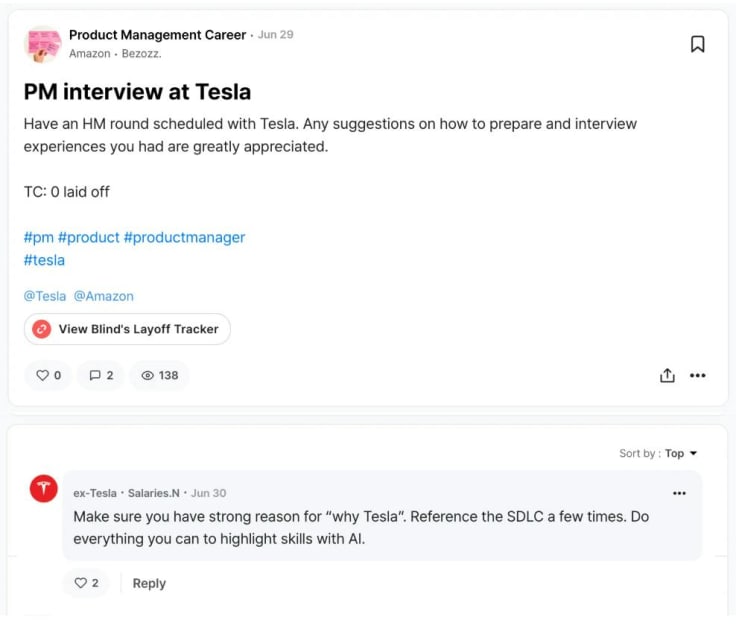
An ex-Tesla employee on Blind advising PM candidates to reference the SDLC and highlight their AI skills as much as possible, 2026
Be ready for a deep-dive into a project you've shipped, down to its tech stack and the systems it depended on. The engineers will ask technical questions, since that's their home ground, but you should expect a few behavioral ones too. These are mostly to gauge if engineers trust your product judgment to share roadmap ownership and make trade-off calls with you.
Candidates have reported questions like:
- Draw the architecture of the last thing you shipped. Which part of that system would break first under 10x load?
- How did you decide what got built in-house and what got bought?
- What do the engineers on your past teams have to say about working with you?
- Have you ever cut scope because engineers didn't have the bandwidth?
5. Cross-functional Leadership
Some loops, mostly for senior PM candidates, include an interview with a senior leader to assess how you've partnered with cross-functional teams (e.g. data engineering, designers, etc). Expect to be asked for stories about working with a large number of stakeholders and working out what each of them needed.
You will also discuss how you rise to challenges and win your peers’ backing while working across teams. You may even be asked about how you’ve aligned people when a decision was inconvenient for them or managed a situation after a failure.
Expect questions like:
- How do you make sure all stakeholders are aligned on what you're trying to achieve?
- Give me an example where you negotiated for resources that were not in your control.
- How do you know the right time to escalate? How do you keep an escalation productive and constructive so that it leads to a collaborative solution?
- How confident are you in your commitments and how do you communicate when the commitments fall through?
6. Ownership
This can be its own round or folded into others, but you should be prepared to face this line of questioning anywhere in the loop. You'll have to lay out how your team worked and walk through a project you shipped, start to finish. The interviewer will keep digging into the calls you made and expect you to either defend them or say what you learned.
Don’t slip into ‘we’ when you’re talking about your contribution to the project and make the manager fish for the details of what you did personally. This is especially important in this round because nothing you say will go unchallenged.
As you narrate the decisions you made, the interviewer will be assessing how you:
- manage disagreements with colleagues and if you can empathize with the people whose points differ from yours radically.
- actively seek out and value chances to grow and learn professionally
- show resourcefulness and a bias for action even when the path/project is not defined clearly
- push yourself and others to deliver against your shared goals
- are able to keep all stakeholders in the loop by tailoring your communication based on the work and audience
In this round, there will be a LOT of ground to cover because you’ll have to narrate and make sure your point lands without dragging out your story. More importantly, you need to narrate these stories with strategic nuance because such rounds help interviewers calibrate your level. The best way to do that is to write a story bank of 6-8 stories before the loop and practice their delivery. A set like this covers 80-90% of the questions you’ll get.
We recommend that you take the classic STAR framework and build it out into STAR+ (Situation, Task, Action, Result + the X-Factor: Learning) to structure your stories. You end each story with a personal takeaway and how it changed the way you work. This way, you’ll demonstrate intellectual humility which adds polish to your seniority.
Expect questions like:
- Have you ever hurt a working relationship because of a conflict? Did it recover?
- How did you react when a project’s priority shifted unexpectedly?
- Have you ever taken the lead on a project and then realized you had incomplete data?
- How do you keep your cross-functional partners accountable for all their deliverables when you’re working on a project?
By now you've probably realized that no 2 Tesla PM loops are identical. A supply chain PM and an energy software PM are judged against the same competencies, but the details of their loops diverge wildly. This guide is an earnest attempt to orient you, but it can't tell you what your loop will look like.
The person best positioned to tell you what you're walking into is a coach who runs these interviews at Tesla. Schedule a mock session where they’ll conduct the session exactly like your real interview. When the day comes, you'll walk in having practised questions built around your own experience, armed with tips that Tesla interviewers themselves gave to you.
That's an insane edge to have over every candidate who has only practised from generic, second-hand questions and is facing a Tesla interviewer for the first time.
Fill out a quick form to get matched with an expert or book directly with a Tesla PM interview coach of your preference.
After the Panel: Evidence of Excellence and Executive Approval
If the HM decides that they should extend an offer to you, your recruiter will ask for your Evidence of Excellence. It's a short write-up of your top achievements (usually 3) that you have to write down. This will be sent to Tesla's executives for sign-off before any offer numbers are discussed and finalized. These used to reach Elon Musk himself, and employees say they now stop a level below him.
That sign-off reflects how hard Tesla makes it to add a single engineer. Andrej Karpathy, ex-Tesla Senior Director of AI of 5 years, says, “At companies by default, teams grow and get large. Elon was always a force against growth. I would have to basically plead to hire people.”
That should give you a sense of the bar. The Evidence of Excellence is your case to an executive that the team needs one more person and it should be you.
It’s pretty unusual for candidates to be turned down at this stage. If your write-up doesn’t make your case strongly enough, your recruiter might come back to you suggesting edits and revisions. Some applications even ask for this early so have a draft ready before you apply just in case.
Tesla Product Manager total compensation
The following figures are in USD:
- P1 (Associate Product Manager): $119.1K
- P2 (Product Manager): $158.1K
- P3 (Senior Product Manager): $216K
- P4 (Staff Product Manager): $272.4K
- P5: $365.7K
View the latest compensation for Tesla product managers on Levels.fyi
Recently reported Tesla Product Manager interview questions
Describe the steps you took to investigate and validate their complaint.
Behavioral
How do you approach and handle the risk of False Negatives when hiring for your product team?
Behavioral, Role Related Knowledge
Tell me about a project where you had a significant impact on the technical direction of the product.
Technical, Behavioral
Frequently Asked Questions
To excel in your Tesla interview, explore these guides to understand how your role interfaces with other departments.
Securing a competing offer is a vital strategy for Product Manager candidates negotiating with Tesla, and the following guides are frequently used to achieve that.
- Apple Product Management Interview Guide
- ServiceNow Product Manager Interview Guide
- Microsoft Product Manager Interview Guide
- Snowflake Product Manager Interview Guide
- Uber Product Manager Interview Guide
- The comprehensive Amazon Product Manager Interview Guide
- Google Product Manager Interview Guide
- Netflix Product Manager Interview Guide
- Meta Product Manager Interview Guide
We regularly update this guide to ensure accuracy. Here's our recent update history:
November 2026
- Published Tesla PM guide