
The Pinterest Software Engineer Interview Guide
This interview guide covers the loop for Software Engineer candidates interviewing at Pinterest. It's been written with the help of 4 Senior Software Engineers and 2 EMs who have worked at Pinterest. Thanks to candidates who are interviewing there in real-time, we've managed to keep this up-to-date with questions asked as recently as September 2026. This guide covers the full loop and lists recently reported questions for each round, including the AI coding round candidates have started to face in 2026.
The Pinterest Software Engineer interview loop runs through these stages:
- Online assessment (new grad and intern loops)
- Recruiter screen
- Technical screen
- Onsite interviews, usually 5 of the following:
Coding
AI-Assisted coding
System Design
Domain deep dive (reported at Staff)
Cross-functional partnership (Staff)
Hiring manager interview
Hiring committee and team matching
The number of coding and design rounds changes with seniority and we’ve discussed these details in the onsite section of this guide.
How Pinterest Evaluates Software Engineers
There are 2 expectations of a Pinterest SWE candidate that run through the technical screen and every onsite interview.
1: Being able to explain your approach.
2: AI fluency.
Pinterest interviews explore your foundational skills alongside how you collaborate with AI.
Most questions and formats in this interview loop exist to help Pinterest see how you work through a problem with your own critical thinking. So unless an interviewer explicitly tells you otherwise, assume that you can’t use AI.
In specific parts of the loop, Pinterest invites you to use AI. That can be an assignment you complete at home or virtually, or a section of a live technical screen where you’re asked to use an AI tool. In such situations, you're assessed on whether you:
- use sound judgment
- give the AI clear direction through effective prompts
- thoughtfully review and evaluate its suggestions
- fully own the outcome, and stay agile enough to deliver a well-reasoned solution
Kent Kassel, Recruiting Lead at Pinterest, says, "Being able to clearly communicate your thoughts, roadblocks, or general questions are all indicators of how well you will be able to problem solve and collaborate at Pinterest."
One of our coaches, a Pinterest Engineering Manager, says interviewers across the onsite also listen for Pinterest's 5 values:
- Put Pinners First
- Aim for Extraordinary
- Create Belonging
- Act as One
- Win or Learn
The hiring manager interview at the end of your loop is the dedicated behavioral round, but you should be prepared for behavioral questions in the other rounds too. They tend to be about why you want to join Pinterest or what your current team is dealing with and the answers you give will be checked against these values.
Given that you’ll be focused on technical answers and your mind may be occupied, you need to land on the right story quickly and make sure it ties clearly to their values. More importantly, you need to narrate them with strategic nuance because such stories are an insight into your seniority.
The best way to be prepared is to write down a story bank of 6-8 stories before the loop and practice their delivery. A set like this covers 80-90% of the questions you’ll get.
We recommend that you take the classic STAR framework and build it out into STAR+ (Situation, Task, Action, Result + the X-Factor: Learning) to structure your stories. You end each story with a personal takeaway and how it changed the way you work. This way, you’ll demonstrate intellectual humility which is the best way to demonstrate the value Win or Learn.
Recruiter Screen
This is a short call with a recruiter to understand your work experience and get a first read on your level. They'll walk you through the interviews you'll sit and what each one covers.
The questions they'll ask are fairly straightforward:
- What have you built that's closest to the work this team does at Pinterest?
- Walk me through a recent project. What did you own, and at what scale?
- What's your timeline like? Are you currently interviewing anywhere else?
Your recruiter is your most valuable resource for anything specific to the role or the interviews. Ask them which level you're being considered for, since the onsite mix changes at each level. Also, confirm whether your onsite has an AI coding round.
Technical Screen
This is a 45-60 minute live coding interview with a Pinterest engineer in CoderPad, and is positioned as the gatekeeper to the onsite.
You'll typically face one progressive problem, so each time your current version runs, the interviewer adds something and your code has to absorb it. Run your code against test cases as you go. If time is running out toward the end, you may be allowed to talk through the last 1 or 2 follow-ups in pseudocode instead of implementing them.
Some problems are built on Pinterest's own domain (e.g. policy violation logs for posts) and the rest are usually close variants of well-known LeetCode problems.
Candidates have reported facing questions like:
- You have a list of policy violation logs, sorted by timestamp. Each log has a post ID and the policy it broke. How many unique posts violated each policy?
- You have a set of elevators, each on some floor and either idle or moving in one direction. Given a passenger's floor and the direction they want to go, which is the nearest elevator that can pick them up?
- A group of friends on a trip logs every expense with details of who paid and who it covered. How would you settle how much is owed by each person and to whom?
- Given a set of bus routes that loop, what is the fewest number of buses you need to take to get from one stop to another?
Run one example with the interviewer before you pick an algorithm, preferably the one that tests whatever you're least sure about. The classic trap is a shortest-time graph problem. It looks like BFS so you start coding and then the interviewer points out a two-hop path that's faster than the direct one. If you find out all this too late, you’ll end up having to rewrite way too much and it could end up costing you a lot. I've seen plenty of strong candidates get caught up in solving and fall for this.
Pinterest Software Engineer Onsite Interviews
The onsite typically runs over video where you’ll code in CoderPad. You'll usually sit 5 interviews of ~60 minutes each, and the mix you’ll face depends on your level.
Pinterest's engineering levels are:
- IC13 (Software Engineer I)
- IC14 (Software Engineer II)
- IC15 (Senior Software Engineer)
- IC16 (Staff Software Engineer and above)
The rounds candidates have reported at each level are:
- At IC14:
- Coding × 3
- System Design × 1
- Hiring manager interview
- At IC15:
- Coding × 2
- System Design × 2
- Hiring manager interview
- At Staff:
- Coding × 1
- System Design × 2, one of them a domain deep dive round
- Cross-functional partnership
- Hiring manager interview
In some 2026 SWE loops, one of the traditional coding rounds is replaced with an AI coding one.
It's also possible that you're asked to sit an extra coding or design round, because your performance was borderline or your level read was ambiguous. Your recruiter will keep you posted about such details so please check in with them every so often.
1. Coding
Like the tech screen, this round is a 60 minute live coding interview with a Pinterest engineer in CoderPad.
Candidates say the problems sit around LeetCode medium, with the occasional hard one reported. At Staff, many candidates agree that the coding round sticks to problems from Pinterest's LeetCode tag with a domain flavor, and stays away from hard algorithm puzzles. Dynamic programming shows up in only a few candidate reports, so don't abandon DP from your prep altogether.
Problems are progressive here too, so expect 3-4 follow-ups to the original. Once these parts run out, interviewers tend to move on to optimizing what you've written, and usually end with a code-review question (e.g. if this were a PR you were reviewing, what would you ask the author to add?).
Expect questions like:
- You are building an escape room tracker. Implement an incrementRoom() method that runs in O(1) time.
- Your version works, but incrementRoom() does not run in O(1). What would you change, and what is the trade-off? - Each pin has a trending score. Build a tracker that records the pins a user has viewed in the last week and can return the highest-scoring pin at any moment.
- Implement add_new_pin, remove_expired_pin and get_top_scoring_pin. What is the runtime of each method? - You are given a list of logs in the form (pin_id, start_time, end_time). Each log represents a window of time during which a user was interacting with that pin. For each second in a 60-second window, return how many pins are active.
- The timestamps can now be any value. Does the same approach still work, and what is the time complexity?
- The same pin can now be active for several users at the same time. Return the number of distinct active pins instead.
2. AI-Assisted Coding
This is a relatively new format that candidates began to face in 2026.
In this version of the coding round you’ll mimic the modern engineer’s habits and work with an AI assistant. You're typically given an existing repo and a written task, and the round evaluates whether you understand the codebase well enough to direct the AI and own the outcomes of its edits. You’ll have to talk through your approach as you go, because you’ll be judged against the AI fluency points we discussed earlier.
While solving, you’ll go through the following 3 phases:
- Code Understanding: You’ll explore the unfamiliar codebase and run a couple of initial tests to analyze existing classes or functions to find your footing.
- Bug Fixing/Code Implementation: Tactfully fix broken implementations, fill in missing logic, add new features and whatever else the task/interviewer asks of you.
- Implementation/ Optimization: Handle edge cases or switch algorithms entirely (e.g., moving from a greedy approach to a trie or optimized search).
Tasks reported for this round look like this:
- Add a read-through cache to this GET API so it calls ProductRepository less often.
- Review the AI-generated changes that add LRU and LFU caches to this codebase. Add tests, and measure the performance of each.
3. System Design
You'll get one of these at IC14 and two at IC15 and Staff. This round is a collaborative discussion where you'll architect a large-scale system or user-facing product by starting off with an open-ended prompt. The interviewer will introduce new data/ constraints partway and you’ll have to talk through how you scale up to the level Pinterest needs, alongside what that might mean for success and failure scenarios.
Our coach, a Pinterest Engineering Manager, says Pinterest draws its design prompts from a small set, with the home feed and notifications among the regulars. Candidates have also reported typeahead and merchant catalog prompts.
What's expected changes with level. At IC14, interviewers are evaluating if you can identify the functional and non-functional requirements clearly and lay out a clean API design. After that, they’ll ask you to go deep on a component or two.
If the interviewer doesn't mention the scale in the prompt, propose one, like 10,000 requests a second, and design to it. You don’t have to get into caching algorithms or a full disaster recovery plan at this level, but you should be able to say where read replicas and horizontal scaling fit, and where a cache belongs.
At IC15, interviewers expect you to take charge of the round completely. Every time you make a tradeoff, you have to say why in the same breath. Also, remember to point out your single points of failure before you're asked.
The system design format is somewhat standardized across the industry so if you need a refresher on the format or are looking for tips, head over to our System Design guide.
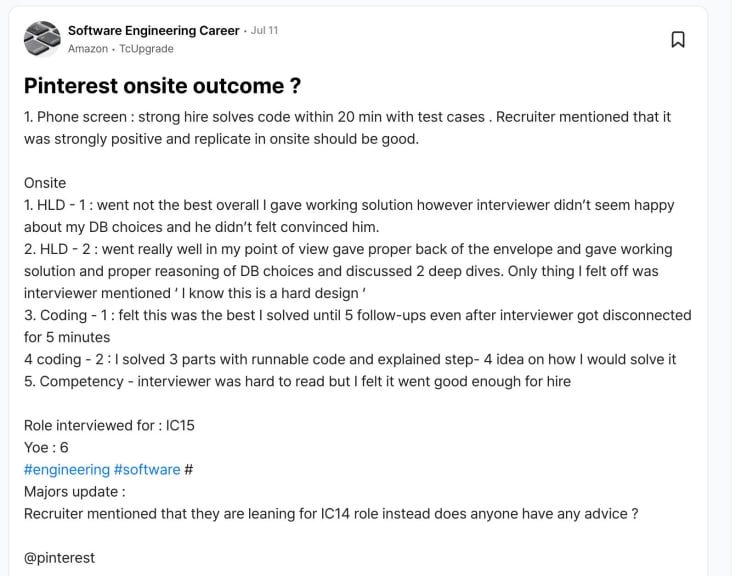
An IC15 candidate on Blind gave a working design in their first high-level design (HLD) round but couldn't convince the interviewer of their database choices, and despite a strong second HLD round, the recruiter came back leaning IC14
Design sessions are almost always what tips the scales on your level, so we recommend that you dry run this round at least once with a coach. Our coaches have been on hiring committees and they say the gulf between IC15 candidates and their downleveled IC14 offers is something that could’ve been fixed with a few targeted tips and practice. Having Pinterest’s interviewers themselves coaching you to go out there and chase the offer you deserve is an insane amount of leverage to have on your end and we think you should strongly consider using it in this competitive landscape.
Let us match you with an expert or book directly with a Pinterest SWE interview coach of your preference.
We've put together a few prompts our coaches use in their own mock interviews so that you can practice on what interviewers themselves prescribe:
- Design Pinterest's home feed that has 300 million daily active users.
- Design search typeahead. Given a prefix, return the top 10 suggestions ranked by popularity, and reflect a trending search right away. Assume 1 billion users making 10 searches a day, and start on a single machine.
- Design a system for merchants to update the attributes on their product pins (e.g. price and stock) alongside images that the server resizes. Plan for 50,000 merchants and 1 billion products.
See the full list of questions for this interview in our free Pinterest Software Engineer interview question bank that's built by vetted reports from candidates and interviewers.
4. Domain Deep Dive
This round, like it says on the tin, tests domain depth, so the shape of the round can vary. Please check with your recruiter what yours covers and who's running it so you have an idea of what to prepare for.
For an Engineering Productivity team, a candidate's recruiter only called it a "domain specific" round and suggested reading up on Pinterest's open-source work.
iOS and web loops go further and reshape several rounds. For example, a Prepfully candidate for an iOS role had no LeetCode in the onsite but spent three rounds building a sample app from scratch. The fourth round was system design focused on iOS.
For data roles, the round runs as a design deep dive into the tools themselves. A Prepfully candidate for a Staff big data role was told one of their two System Design rounds would be general and the other would be on big data. A Prepfully coach who manages data and analytics work at Pinterest says the round leans on the tools Pinterest runs at scale, like Spark, Kafka, Hadoop and the data warehouse. For another Staff data candidate, the round went into Kafka consumer group rebalancing and Spark shuffle internals.
5. Cross-Functional Partnership
This interview usually shows up in Staff-level loops. This round focuses on how you build and maintain working relationships across the org with teams that don’t report to you directly. Interviewers will look for evidence that you can maintain relationships with PMs, data scientists, etc. who have to deliver on your initiatives without leaning on your rank and instead, use data and reasoning to keep everyone aligned.
You’ll talk through how you won buy-in for engineering work, like paying down tech debt during planning, against a roadmap full of product features. You’ll have to tie your projects to the metrics or OKRs they moved, and show how you helped other engineers grow.
Be prepared to answer questions like:
- What do you do if a senior from a different org challenges your approach?
- How do you use input from other teams in your decision-making process?
- Have you been in a situation where a key XFN partner was underperforming?
6. Hiring Manager Interview
This is a behavioral interview with a hiring manager who’ll ask questions about your experience and past work to understand:
- how you make decisions
- how you decide what is worth building
- how you handle disagreement
- how you build trust across a team/org
- how you raise the bar (for yourself and the overall business)
The interview can also cover
- details of your most complex project and the impact of it
- a system design question related to the hiring team's work
All your answers in this round will be read against Pinterest’s values so this round will benefit greatly from your story bank (discussed under the “How Pinterest Evaluates Software Engineers” section if you missed it).
Expect questions like:
- Tell me about a time you shipped an MVP. What did you do to keep improving it?
- How do you judge whether you’ve written enough tests? Are there any instances you think it’s acceptable not to write tests?
- Have you ever disagreed with a team decision/direction? What did you do about it?
- Have you ever strained a working relationship?
- Have you ever taken the lead on a project where nobody had the full picture?
Hiring Committee and Team Matching
After the onsite, every interviewer submits written feedback, and the panel meets to decide on a hire and level decision.
Once they have a unanimous hire decision, you’ll be put into the team matching phase and the offer is only sent out once the match has been finalized. Our coaches say that candidates with the strongest ratings are usually prioritized in this phase.
Pinterest Software Engineer Total Compensation (USD)
- IC13 (Software Engineer I): $224.8K
- IC14 (Software Engineer II): $332.8K
- IC15 (Senior Software Engineer): $490.2K
- IC16 (Staff Software Engineer): $705.6K
The range tops out at $1.6M at IC18.
View the latest compensation for Pinterest software engineers on Levels.fyi
Recently reported Pinterest Software Engineer interview questions
<div class='problem-card'><h3>Diameter of a Binary Tree</h3><p>Find the diameter of a binary tree.</p><div class='example'><p><strong>Input:</strong> root = [1,2]</p><p><strong>Output:</strong> 1</p><p><strong>Explanation:</strong> The longest path is simply the single edge connecting the root node to its only child.</p></div></div>
Coding
<div class='problem-card'><h3>Product of Array Except Self</h3><p>Calculate the product of an array except for self without using division.</p><div class='example'><p><strong>Input:</strong> nums = [-1,1,0,-3,3]</p><p><strong>Output:</strong> [0,0,9,0,0]</p><p><strong>Explanation:</strong> The single zero zeros out all products except at its own index, which cleanly multiplies the remaining elements.</p></div></div>
Coding
<div class='problem-card'><h3>Merge a New Interval</h3><p>Merge a new interval into a list of non-overlapping intervals.</p><div class='example'><p><strong>Input:</strong> intervals = [[1,2],[3,5],[6,7],[8,10],[12,16]], newInterval = [4,8]</p><p><strong>Output:</strong> [[1,2],[3,10],[12,16]]</p><p><strong>Explanation:</strong> The new interval overlaps with [3,5], [6,7], and [8,10], merging them all into the unified block [3,10].</p></div></div>
Coding
Frequently Asked Questions
Most Pinterest behavioral interviews test stakeholder management; these guides provide essential context on those partner roles.
Successful Software Engineer candidates often have parallel interviews lined up to help with Pinterest salary negotiations, which is why the following guides are so frequently used.
- Oracle Software Engineer Interview Guide
- Rippling Software Engineer Interview
- The Ultimate DoorDash Software Engineer Interview Guide
- The Comprehensive Tesla Software Engineer Interview Guide
- Uber Software Engineer Interview Guide
- The Comprehensive Apple Software Engineer Interview Guide
- The Ultimate Coinbase Software Engineer Interview Guide
- Microsoft Software Engineer (SWE) Interview Guide
- Amazon Software Development Engineer (SDE) Interview Guide
We regularly update this guide to ensure accuracy. Here's our recent update history:
November 2026
- Added AI Coding onsite round
- Added AI fluency rubric
June 2026
- Refreshed IC13-IC18 total comp ranges.
- Updated technical screen and onsite coding questions
November 2024
- Standardized level-specific onsite loops
April 2022
- Updated Pinterest's 5 company values
March 2022
- Published original Pinterest Software Engineer guide