Bloomberg Software Engineer Interview Guide
The Bloomberg Software Engineer interview: code review rounds, C++ legacy systems, financial domain knowledge, and 'Why Bloomberg’, what 2024-2025 candidates faced and how to prepare successfully

The Bloomberg Software Engineer Interview Process Round by Round
Bloomberg's software engineer interview is different from most tech companies. Technical skills are the baseline, you're expected to solve coding problems correctly. But that's not what decides if you get an offer. According to Bloomberg candidates on Prepfully, several people solved every problem perfectly and still got rejected. The reason (not entirely surprisingly, given the increased focus a lot of companies put in this): Behavioral fit and genuine interest in Bloomberg's mission. You’ll see us refer to this theme multiple times in the rest of the guide.
The Bloomberg software engineer interview lasts 3-7 weeks and tests whether you can build systems for financial markets when milliseconds count and a single point of error is unacceptable. This guide covers the Bloomberg Software Engineer interview process with insights from Prepfully Bloomberg engineers and recent candidates, breaking down each round alongside preparation tactics that have worked well.
Bloomberg structures its software engineer interview process into discrete stages, each testing different aspects of your skills.
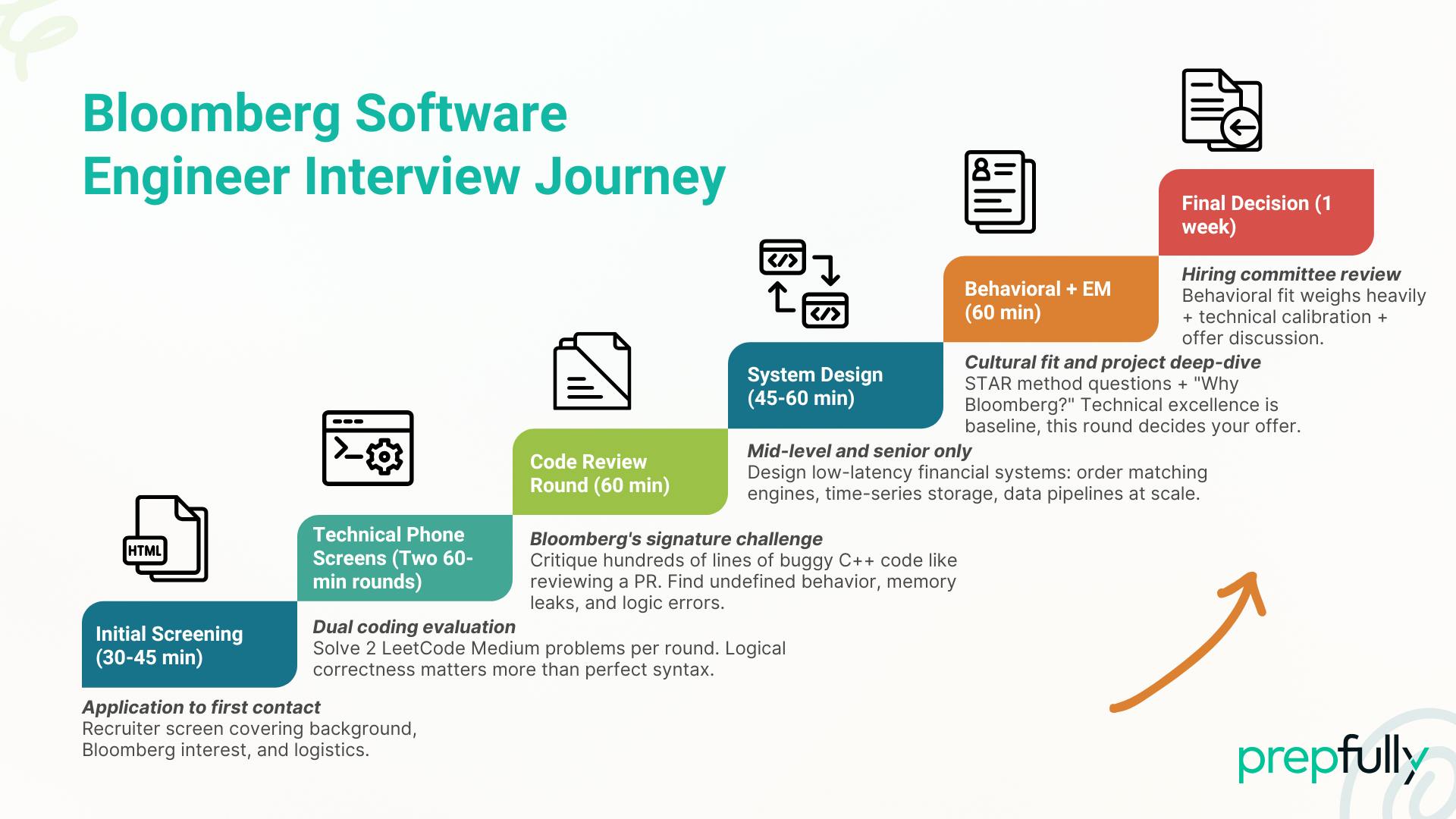
Complete Bloomberg SWE interview journey showing all 5 rounds, note how the final Behavioral + EM round explicitly states 'Cultural fit and project deep-dive,' where technical excellence becomes baseline and behavioral fit decides your offer
Round 1: Recruiter Screen (30-45 minutes)
Overview
The recruiter checks your background, asks why you're interested in Bloomberg, and assesses whether your experience matches what they need. They'll also cover logistics, preferred office location, visa status, and salary expectations. This round focuses on background verification and basic fit assessment, no coding or technical problem-solving.
You have to think out loud whatever you are thinking. So for example, at the end of this second problem you were trying to debug things, right? But you were thinking within yourself. So if you think out loud, probably the interviewer can help you. But otherwise, yeah, I mean if you don't have optimal solution in mind, you just go with the non optimal solution and you can iterate on top of that if there is still time. And also I wanted to mention that for your role you seem to be in the trading kind of role, right? Yeah, you can probably expect mathematical kind of questions and also string manipulation questions. It's more team dependent.
Round 2: Technical Phone Screen (Two 60-minute rounds)
Overview
You'll do two separate technical phone screens via Zoom and HackerRank. Each round follows a similar format: 10-15 minutes of introductions and resume discussion, 40 minutes of coding problems, and 5-10 minutes for your questions.
What makes Bloomberg different: your code doesn't need to compile or run. Interviewers care about logical correctness, optimal complexity, and clear communication over perfect syntax. Each round typically has 2 problems at LeetCode Medium difficulty.
Some of the questions Bloomberg candidates reaffirmed they were asked in their Prepfully debriefs:
- Design Hit Counter (LC 362)
- Find Peak Element variant
- Combination Sum (LC 39)
- Min Stack (LC 155)
- Wordle Checker Function (custom Bloomberg problem)
Round 3: Code Review Round (60 minutes)
Overview
This round is unique to Bloomberg. You'll receive several hundred lines of intentionally buggy code and critique it like you're reviewing a pull request from a junior developer. According to Prepfully candidate debriefs, the code includes real bugs like iterator misuse (if (it.end() == map.end()) causing undefined behavior), uninitialized Boolean variables, and logic errors in boundary conditions.
You'll also analyze log files to identify runtime issues. Bloomberg uses this round to test your code quality thinking beyond solving algorithm problems. They want to know if you can maintain their massive C++ codebase.
Round 4: System Design (45-60 minutes, mid-level and senior only)
Overview
Entry-level candidates don't get system design questions. If you're applying for mid-level or senior roles, expect one or two design rounds focused on low-latency financial systems.
Questions Bloomberg software engineer candidates on Prepfully told us they received:
- Design an order matching engine
- Build time-series data storage for historical stock prices
- Scale a data pipeline from thousands to millions of files per day
Interviewers focus on WHY you make each choice and HOW you handle failures, not only whether you mention Kafka or Spark. They probe trade-offs: throughput vs latency, exactly-once vs at-least-once semantics, consistency vs availability.
Round 5: Behavioral and Engineering Manager
Overview
The final round includes behavioral questions using the STAR method and a deep dive into your past projects. The hiring manager wants to understand your technical decision-making process, why you chose each approach, what failed, what you learned.
Communication gets weighted equally to technical ability. According to a 2025 new grad candidate on Reddit: "They don't need a big fancy project to pass. What they assess is your technical decision-making ability, not the impressiveness of your project. Just know your project well, speak frankly, and you'll be fine."
The "Why Bloomberg?" question is critical. Responses which feel “AI assisted” or “generic” are not going to work (so don’t say something abstract like “it’s a good company”, or “it has interesting tech to work on”. You must demonstrate serious interests in infrastructure development of international markets; or just tie it into your past background on why you’d be a good fit, that’s always an excellent way to show motivation for a particular company.
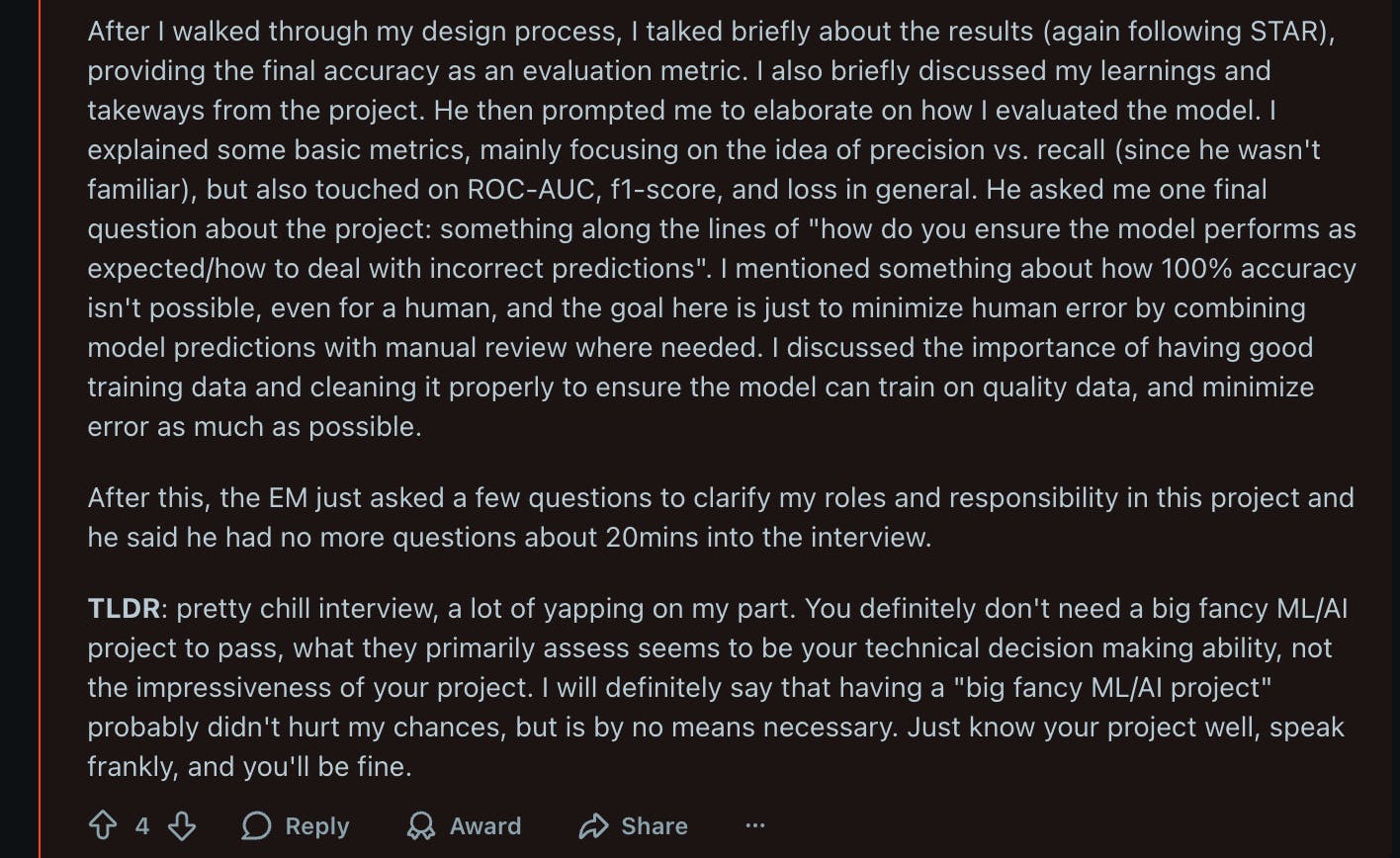
Technical decision-making ability matters more than project complexity at Bloomberg behavioral rounds (Source: Reddit)
What Gets You Rejected in Bloomberg Software Engineer Interviews
Based on the experience of candidates who were successfully verified, we have gotten to know something significant: knowing how to answer all the coding questions does not mean an offer. The technical rounds help Bloomberg sieve out individuals incapable of coding, but the ultimate decision seems driven quite a bit on the fit for their culture and their assessment of your passion for the role.
Candidates identified these red flags that lead to rejection:
- The presence of competitor interviews at the behavioral round is an indication that you are not interested in Bloomberg, per se.
- Criticizing Bloomberg's older C++ code during interviews. Bloomberg has a massive C++ codebase built over decades, and some of it uses older patterns or non-modern syntax. If you look at legacy code during the code review round and say things like "this should all use modern C++17" or "why don't you just refactor this," you're showing you don't understand the reality of working with mature codebases. They want people who can work with existing systems, not bulldoze them.
- Motivation around things such as “salary levels” or “it’s a prestigious organization” is not perceived as sufficient - your motivation should be tied to the kind of work you’ll be doing at Bloomberg in a convincing way
- Boasting/feeling too good about yourself or saying something potentially arrogant-sounding like “the systems at Bloomberg have to be rewritten” will be offputting. There’s a lot of inherent pride in existing systems.
One verified Bloomberg employee on Blind captured it perfectly: "Bloomberg coding interviews aren't particularly difficult so you're expected to pass those. It's most likely your answers to the behavioral questions."
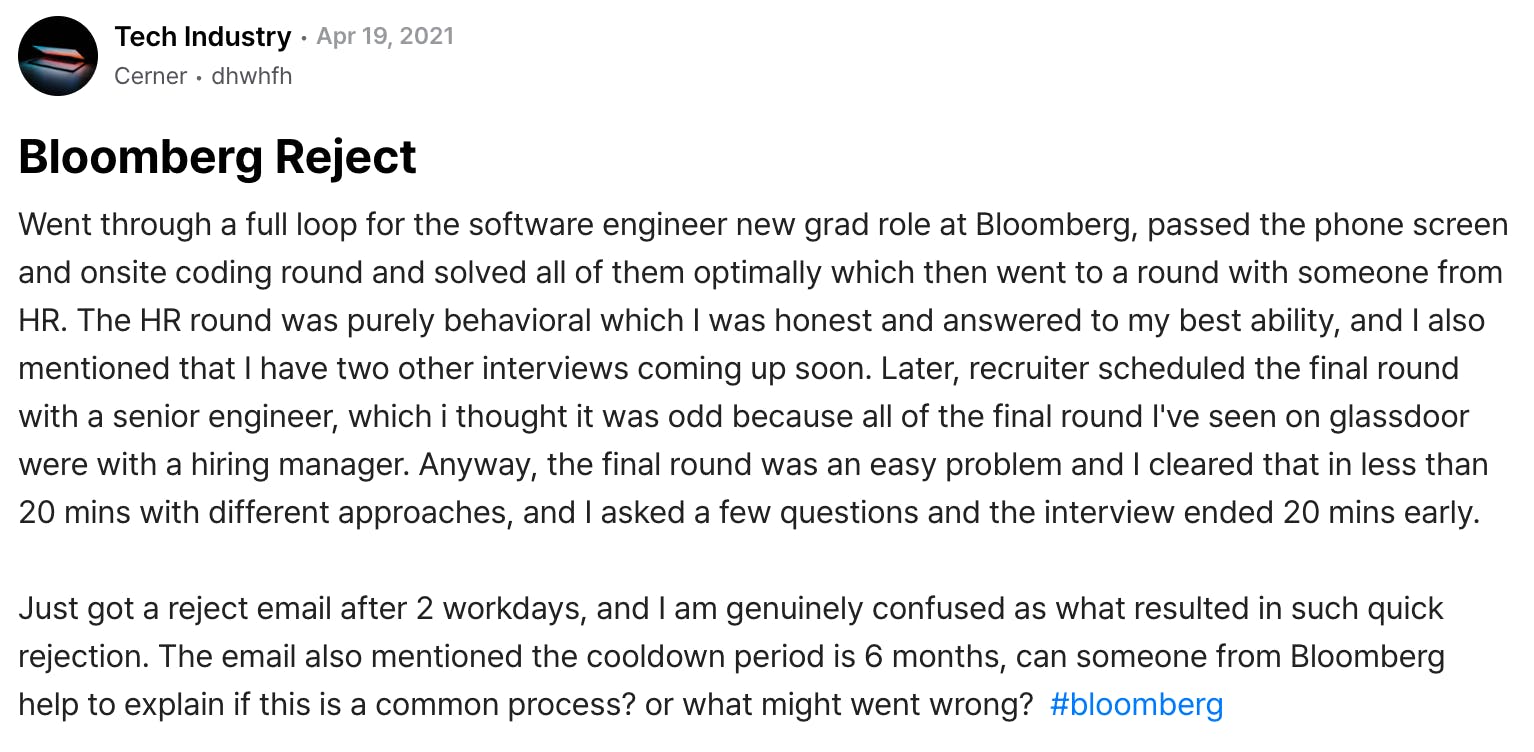
Bloomberg rejection despite passing all technical rounds, behavioral fit determines final decisions (Source: Blind)
Get coached by Bloomberg engineers on Prepfully to master the code review round and nail your 'Why Bloomberg' answer before your interview.
→ Schedule NowHow to Prepare for the Bloomberg SWE interview
Coding Prep (6-8 weeks)
Practice 150-220 LeetCode problems with a focus on Medium difficulty and Bloomberg-tagged questions to prepare for Bloomberg software engineer interview questions. According to successful Bloomberg candidates on Prepfully, this distribution works well:
- 30% Easy problems
- 60% Medium problems
- 10% Hard problems
Key topics: arrays, strings, hash maps, trees, graphs, dynamic programming, and sorting/searching.
Practice without IDE autocomplete since Bloomberg's interview environment is bare-bones. Use HackerRank or similar platforms to get comfortable with basic editors.
High-frequency problems Bloomberg software engineer candidates on Prepfully told us they encountered:
- Merge Intervals (LC 56)
- Insert Delete GetRandom O(1) (LC 380)
- Min Stack (LC 155)
- Number of Islands (LC 200)
- LRU Cache (LC 146)
Code Review Prep
This is unique to Bloomberg. DRilling Review My Code on GitHub, Select and Find Bug in an Open-source Project. Train yourself to spot:
- Edge cases and undefined behavior.
- Memory leakages and un-initialized variables.
- Logical fallacies in boundary conditions.
- Bad code structure and design patterns.
Think like you're reviewing a PR from someone junior who needs constructive feedback.
System Design Prep (for mid-level and senior)
Bloomberg's system design interviews test your ability to architect systems that solve financial infrastructure problems at scale. You need to know the major components that go into high-performance technical systems and the tradeoffs involved in each option. Here's how to approach it:
Start by understanding the problem. Take time to clarify the requirements, define scope, and articulate your goals before touching any architecture. Say something like "Let me make sure I understand what we're building here" and lay out your assumptions. This also gives the interviewer a chance to steer you in the direction they want.
Listen carefully for interviewer signals. They know the scope is infinite and they have specific themes they want to cover to assess you across different areas. You'll get hints like "let's assume latency isn't a concern here" or "what if this needs to serve global markets across different time zones?" These are cues to shift your focus. If they say the first thing, move on from your low-latency optimization discussion. If they say the second, dive into geographic distribution, CDNs for static data, and how you'd handle market hours across regions.
Present multiple options and make deliberate choices. You should constantly be coming up with alternatives for the constraints you face. That's what they want to see. Mention 2-3 options succinctly, explain the tradeoffs ("Option A gives us better read performance but complicates writes, Option B is simpler but might not scale as well"), then pick one with clear reasoning.
Be honest when you're stuck. There will be moments where you don't know something or aren't sure what the interviewer wants. Don't try to bluff. Say "I'm not familiar with that specific technology, but here's how I'd think about the problem" or "I'm not sure which direction you'd like me to explore, would you like me to dig into X or Y?" Honesty and structured thinking matter more than knowing every tool.
Practice with Bloomberg-relevant scenarios. Don't just practice generic "design Twitter" problems. Think about financial systems:
- How would you design a real-time stock ticker update system serving 350,000 terminals with sub-50ms latency?
- How would you build a trade matching engine handling thousands of orders per second?
- How would you design time-series storage for historical market data with efficient querying?
- How would you scale a data ingestion pipeline from thousands to millions of files daily?
For each, think end-to-end: data sources and ingestion, processing and validation, storage choices (SQL vs NoSQL vs time-series databases), caching strategies, API design, how you'd handle failures, and how you'd ensure data accuracy (critical in finance).
Bloomberg-specific considerations you should address:
- Data accuracy is non-negotiable. Financial systems can't tolerate inconsistencies. Talk about validation, reconciliation between sources, and audit trails.
- Low-latency requirements. Many Bloomberg systems need sub-50ms delivery. Discuss in-memory caching, data structure choices, and network optimization.
- 24/7 global operations. Markets never sleep. How do you handle peak load during market open/close? How do you plan maintenance windows?
- Regulatory compliance. Touch on encryption, access control, and audit logging when relevant.
Behavioral Prep
Research Bloomberg products beyond the Terminal, Bloomberg Law, enterprise data services, news operations. Your "Why Bloomberg?" answer needs to connect to their mission of bringing transparency to financial markets.
Prepare STAR stories that show:
- Problem-solving in ambiguous situations
- Collaboration with difficult team members
- Learning from failures (be honest about what went wrong)
- Technical decisions and trade-offs you made
Bloomberg values authenticity. Admitting knowledge gaps is better than pretending to know everything. They hire "learn-it-alls" not "know-it-alls."
Mock Interviews
Bloomberg candidates on Prepfully who did mock interviews had much better pass rates. One person who got rejected multiple times across several roles directly asked their Bloomberg coach: "Why am I not getting hired, what am I doing wrong?" This candor (incidentally a core Bloomberg value), led to an honest conversation, a great deal of candid feedback from a coach on gaps and opportunities, and eventually an offer.
Practice explaining your thought process out loud. Get comfortable with follow-up questions and pushback on your decisions. Bloomberg interviewers probe deeply to see if you understand trade-offs or have only memorized patterns.
Compensation and Levels
Bloomberg uses a cash-heavy compensation structure since they're a private company with minimal equity.
Entry-Level (L3, 0-2 years experience)
- Base salary: $155,700-$173,000
- Annual bonus: $23,760-$29,700
- Stock/RSU: $1,600-$2,000 (minimal)
- Total compensation: $188,000-$204,000
- Sign-on bonus: $10,000-$30,000 (negotiable)
Senior Software Engineer (L5, 5-8 years experience)
- Base salary: $220,500-$245,000
- Annual bonus: $48,400-$60,500
- Stock/RSU: $2,640-$3,300 (minimal)
- Total compensation: $277,000-$312,000
What's Different About Bloomberg Compensation
No significant equity component since Bloomberg is private. This means highly predictable cash compensation but less upside potential compared to equity-rich offers from public companies like Meta or Google.
The 75% 401(k) match on the first 8% of salary is generous, caps at about $7,750 annually. Profit-sharing contributions vary by year based on company performance.
Benefits (estimated $27,000 annual value)
- Free breakfast, lunch, and unlimited snacks daily
- 26 weeks maternity leave, 4 weeks paternity leave
- On-site medical clinics at major offices
- $5,000 annual charitable donation matching
- Global museum access for you and your family
- $300 annual gym reimbursement plus on-site fitness centers
Negotiation
Focus on three levers: base salary, target bonus, and signing bonus. One candidate successfully negotiated their offer from $250,000 ($205K base + $45K bonus) to $265,000 ($220K base + $45K bonus) by presenting a competing offer.
Negotiation tips from Bloomberg candidates on Prepfully:
- Competing offers work but need to be in writing from legitimate companies
- Gap needs to be material (15%+ difference)
- Bloomberg expects negotiation and won't pull offers for trying
- RSUs show more flexibility than base salary when base is at ceiling
Geographic Pay Differences
NYC: Highest compensation with 10% premium over other locations. About 4,096 engineers in New York.
San Francisco: Average $178,722 for software engineers despite smaller office presence.
London: 521 engineers, compensation adjusted for UK market rates and taxes.
Hong Kong: HK$769,000-$1.29M total ($99K-$166K USD) depending on level.
India (Pune): ₹33-59 lakhs ($40K-$72K USD) with 149 engineers in growing hub.
The Bloomberg SWE Interview tl;dr
What to remember about Bloomberg software engineer interviews:
Technical excellence is the baseline, not what differentiates you. You're expected to solve coding problems correctly. Behavioral fit and genuine interest decide the final outcome.
Code review round is unique to Bloomberg. No other major tech company tests this way. Practice reviewing buggy code and thinking about maintainability.
Entry-level roles don't include system design. If you're applying for junior positions, focus your prep time on coding and behavioral questions.
"Why Bloomberg?" needs genuine depth. Generic tech company enthusiasm fails. Connect to financial markets, market transparency, or the specific products Bloomberg builds.
You need to solve problems correctly, communication alone won't carry you. There's a myth that your "way of thinking" or communication can carry you through without solving the problem. That's not true. You need to solve coding problems correctly. However, Bloomberg does value clear communication and the ability to explain your reasoning while you work through solutions.
C++ knowledge helps but isn't required for entry-level. Python and Java are both accepted. Choose your strongest language. Senior roles need more C++ proficiency.
Mock interviews dramatically improve success rates. Bloomberg candidates on Prepfully who practiced with mock interviewers report that working with someone who asks follow-ups and pushes back on decisions made a huge difference.
Negotiation focuses on cash components. Base salary, annual bonus, and sign-on bonus are your levers. Bloomberg is private so equity negotiations don't apply.
Application timing matters. Early October is best before November hiring freezes. January-March for spring cohorts also works well.
Need help with Bloomberg's unique code review round? Connect with Bloomberg Software Engineer coaches on Prepfully who can give you targeted feedback on your approach to legacy code and behavioral questions.
→ Schedule NowRecently reported Bloomberg Software Engineer interview questions
<div class='problem-card'><h3>Find the majority element in an array.</h3><p>Given an array of size n, find the majority element. The majority element is the element that appears more than ⌊n / 2⌋ times. You may assume that the majority element always exists in the array.</p><div class='example'><p><strong>Input:</strong> nums = [3, 2, 3]</p><p><strong>Output:</strong> 3</p><p><strong>Explanation:</strong> The number 3 appears 2 times, which is strictly greater than n/2 (1.5).</p></div></div>
How would you approach designing a database cluster that can handle mixed read-write workloads?