
Uber Frontend Engineer Interview Guide
This interview guide covers the entire interview loop for the Uber Frontend Engineer interview. It has been compiled with input from 1 front-end engineer and 1 senior front-end engineer who have both worked at Uber. The guide also includes technical and non-technical questions reported by candidates in 2026 interviews.
The interview process for Uber Frontend Engineer (FEE) differs according to the level of the position. Overall, the process may look something like this:
- Recruiter Screen
- HackerRank Assessment (L3 only)
- Hiring Manager Screen and Technical Architecture Screen (L6+ only)
- Business (Technical) Phone Screen
- Onsite Loop, 3-6 rounds depending on the level of the position
- Final Decision
Note that the exact stages, order, and interview platform may vary by team, level, and location. Your recruiter will confirm the exact format of your loop.
Candidates report that the entire interview process can take 3-6 weeks end-to-end, but it can also stretch to nearly 2 months.
Uber makes it clear that candidates are not allowed to use AI tools during the interview unless specifically told otherwise by the recruiter. This includes generative AI tools like ChatGPT, automated response generators, and code auto-completion tools. Any technical or case-based problem-solving in the interview has to be explained without AI assistance unless AI agents are a part of the coding environment in the interview. Your recruiter will confirm in advance if that is the case.
How Uber Evaluates Frontend Engineer Candidates?
Uber states that it looks for the following values in candidates:
- Go get it: Bring the mindset of a champion, hustle, embrace the grind, overcome adversity, and play to win for the people served.
- Trip obsessed: Make magic in the marketplace, make difficult trade-offs, blend algorithm with human ingenuity, create simplicity from complexity, and get the balance right.
- Build with heart: Build products that positively impact Uber’s partners and the communities at large.
- Stand for safety: Embed safety into everything.
- See the forest and the trees: Know the details that matter while seeing the big picture.
- One Uber: Bet on something bigger, actively support your teammates, disagree and commit, and celebrate progress together.
- Great minds don’t think alike: Embrace and seek out diversity of ideas, identity, background, experience, and education to make better decisions.
- Do the right thing: Act with integrity.
Additionally, Uber’s success attributes guide how it assesses candidates. These attributes are:
- Adaptability
- Bias Towards Action
- Collaboration
- Entrepreneurial
- Grit
- Interpersonal Influence
- Inquisitiveness
These values and attributes have loop-wide relevance. So, every interviewer at every stage will be evaluating you for them.
Uber also uses job-related competencies to make hiring decisions. These competencies are:
- Collaboration and Leadership
- Design and Architecture
- Software Engineering
These competencies may be used at different stages of the interview process. Your recruiter will share the competencies you will be assessed for.
Recruiter Screen
This is a 30-minute call with a member of the Talent Acquisition team. The recruiter will ask questions about your background, experience, and skill set to confirm mutual fit. Logistics, compensation expectations, and “Why Uber?” may also come up during the conversation.
Expect the questions in this round to be like this:
- Tell me about yourself.
- Walk me through your resume.
- What makes you interested in working for Uber?
- Tell me about a challenging frontend project you worked on.
For the Why Uber question, we recommend going through the company’s engineering blog to familiarize yourself with its latest work.
The recruiter will also tell you what competencies you’ll be assessed on and at which level. The level you are pitched at here, however, is provisional until the business (technical) phone screen. So, you can ask them which level you’re being considered for, whether your track includes the online assessment, and which editor the coding rounds use.
HackerRank Assessment
L3 candidates have to do a HackerRank coding assessment before the technical phone screen round. The details about the duration, questions, and difficulty will be mentioned in the invite email itself. Uber states that the assessment will focus on data structures and algorithms (DSA) and problem-solving strategies but candidate reports say there can be some frontend questions as well.
You can code in any language of your choice but external IDEs are not allowed in the test. You have to use the built-in editor provided by HackerRank. Additionally, candidates report some multiple-choice questions in the assessment as well.
Expect the questions in this round to be like this:
- Find the lowest total ticket price given a set of cities, prices, and a maximum number of stops.
- Build a simple To-do list with add/delete functionality using React.
Practice solving problems on HackerRank, especially in JavaScript, with its built-in editor for the assessment. The sequence we have often seen working is to complete the simpler problems first and then go in for the more complex ones. Keep some time aside towards the end for testing since it's easy to lose that time if you don’t plan for it beforehand.
Hiring Manager Screen and Technical Architecture Screen
Candidates interviewing for L6 and above roles for Uber FEE have to face hiring manager screens before getting to the technical phone screen round. There are two separate 60-minute interviews. The first is about evaluating your leadership, scope of experience, and alignment with Uber’s goals and values. The second interview tests the depth and breadth of your technical knowledge.
Therefore, you can expect a mix of behavioral and project deep-dive questions in these rounds. The hiring manager will probe into your skills, decision-making, approach to problems at scale, and understanding of frontend challenges at Uber’s scale.
Some examples of questions for this round are:
- Tell me about the most complex frontend project you have owned.
- What is the most innovative idea you have ever thought of?
- How do you decide between improving quality and shipping quickly?
- Tell me about a time you disagreed with a designer, backend engineer, or product manager.
- Did you ever make a decision that did not go as planned? What did you learn from it?
Create a story bank structured with the STAR+ framework for the Hiring Manager Screen. This is a tip we always give to candidates based on coach inputs in our mock interview sessions. We have talked about this in more detail in the Collaboration and Leadership section.
Business (Technical) Phone Screen
This is a 60-minute pair programming interview covering both coding and design and architecture (D&A). This is the round that determines the initial level you move forward with. The final level is, however, determined only after the interview panel’s debrief session.
For L3–L5B candidates, 45 minutes are reserved for solving problems on HackerRank and the remaining 15 minutes are for discussing the scope and complexity of your past projects with a D&A lens.
For L6+ Uber FEE roles, the technical phone screen focuses on technical architecture. There is no coding aspect here. The interviewer will, instead, look into your technical depth and breadth, especially in D&A. You’ll be expected to show your ability to handle complex challenges by discussing your past projects, trade-offs, design decisions, their rationale, their impact on project success, and the lessons learned.
L3–L5B candidates can use any language of their choice for the coding part. This screen is the round with the most variety. You may get async JavaScript, a React task, or a LeetCode medium problem. The focus areas for this round are:
- Common DSA topics such as hash tables, trees, and stacks
- Data structures like arrays, stacks, queues, hash tables, trees, graphs, and heaps
- Runtime Analysis (Big-O notation) and optimization techniques
- Solving problems common in large-scale tech companies
Therefore, expect the questions in this round to be like:
- You’re building a word search feature for a 2D character grid. Given an m x n grid board and a string word, return true if the word can be formed from sequentially adjacent cells. Adjacent cells share an edge, and a cell cannot be used more than once in the same path.
- Given an array of intervals where intervals[i] = [starti, endi], merge all overlapping intervals, and return an array of the non-overlapping intervals that cover all the intervals in the input.
Practice writing and explaining your code in a live coding environment for the technical screen. Uber states that it expects candidates to write clear and readable code with consistent formatting in this round. The interviewer will want to see both your solution and how you arrived at that solution.
Our coaches recommend focusing on speed and practicing solving problems quickly so you have ample time to spare for testing and debugging.
For the project discussion, pick one that highlights the scope and complexity of your role and be ready to discuss every aspect of it, especially the trade-offs you made.
It is also worth having some questions ready about the role or team. It shows your genuine interest for the position and helps you figure out whether the position is the right fit for you or not.
Uber Frontend Engineer Interview Onsite Loop
The onsite loop for the Uber Frontend Engineer interview process comprises 3-6 rounds depending on the level of the position. It will evaluate your proficiency in DSA, frontend specialization, design and architecture, and assess your cultural fit at the company. Candidates report that the FEE loop runs on async JavaScript and framework-free.
Most rounds in the loop run for 60 minutes, but for L5A candidates, the design and architecture discussion on a previously solved problem is combined with leadership and collaboration and lasts for 75 minutes.
For L5B candidates, the design and architecture discussion on a previous project also involves an Impact–Efficiency and Quality interview. This combined round runs for 60 minutes, but for L6+ candidates, the latter is a separate interview round.
It consists of the following rounds:
- Data Structures and Algorithms (DSA)
- Depth in Specialization Coding
- Design and Architecture – New Problem (L4+)
- Design and Architecture – Previously Solved Problem (L5+, combined with Collaboration and Leadership for L5A and Impact–Efficiency and Quality for L5B)
- Collaboration and Leadership
- Impact–Efficiency and Quality (L6+ only)
The loop generally takes place virtually over Zoom but candidates may also be called onsite for the interview. Please confirm with the recruiter the exact format of your loop.
Data Structures and Algorithms (Coding 1)
This is a 60-minute paired coding round where you have to solve medium-hard DSA problems in a shared editor, usually HackerRank or CoderPad. Please confirm the platform with your recruiter before the interview begins.
Uber states that the problems in this round will not be tied to any specific technical domain but you are expected to write clear, readable, and testable code. You can use any language of your choice here.
This is a DSA round on paper, but in practice, you are as likely to get an async utility problem as a LeetCode medium one. Frontend loops often run it in JavaScript or TypeScript so it's good to be prepared for both.
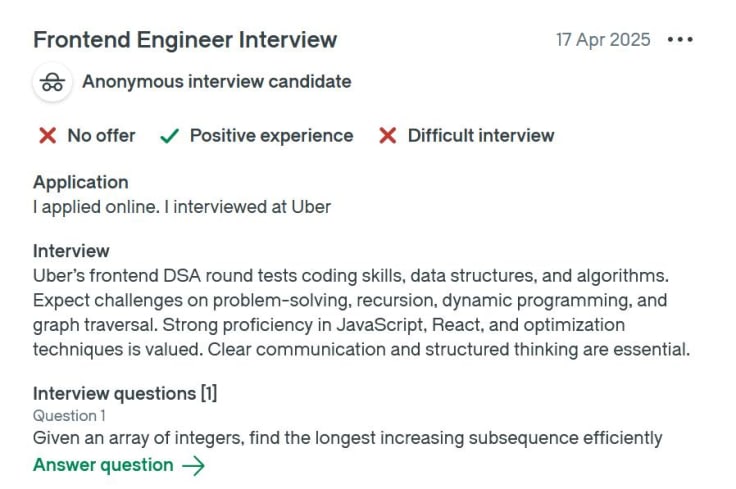
A candidate details the DSA coding round for the Uber frontend engineer role on Glassdoor, recorded in 2025
Candidates report the following types of questions in this round:
- You are given an m x n binary grid which is initially filled with 0s (water). You are also given an array positions where positions[i] = [ri, ci] is the position (ri, ci) at which you should perform an add land operation. After each add land operation, you want to know the number of islands in the grid. An island is a group of connected 1s (land). Return an array of integers representing the number of islands after each land operation.
- Design and implement a task queue in TypeScript that supports controlled concurrency. The queue should allow executing up to K tasks in parallel, while additional tasks are queued until slots become available. Each task should have a unique task ID and support success and error callbacks. The design should also allow setting a custom executor to define how tasks are executed.
The interviewer will evaluate how you approach the problem and solve it. Our coaches say that it’s better to be upfront about the time/space complexity and how you will optimize your code to improve it before you start coding.
The interviewer might add new constraints or requirements as you code, so you need to modify your solution accordingly.
Depth in Specialization Coding (Coding 2)
This is a 60-minute interview in which you will write code to solve a problem similar to what you would encounter in the Uber FEE role. Uber states that it may ask candidates to modify a project provided by them or implement something from scratch in this round. The goal is to assess your technical depth and expertise in your area of specialization.
L3 candidates can code in any language of their choice, but L4 and above candidates are specifically asked to code in JavaScript or React in this round. Further, L3 candidates can expect questions related to lists, hash tables, stacks, graphs, binary search, and tree operations.
Concepts like JavaScript, HTML, asynchronous JavaScript, DOM manipulation, debugging, promises, race conditions, and component separation are more important for L4+ candidates.
Expect the questions in this round to be like this:
- Design and implement a modal component using any UI framework of your choice. Close all other open modals when a higher-priority one opens.
- Build a Grid Light Box in React where lights deactivate in reverse order of activation.
- Implement a mapAsyncLimit function that takes an array of asynchronous tasks and an optional concurrency limit.
- In JavaScript, how would you code a function to compute the maximum sum of any continuous subarray within an array of integers?
We recommend mastering asynchronous JavaScript and practicing solving problems in React for this round. Start with a working solution and optimize it as you go. Finish by providing a usage example that exercises the component because the interviewer may try to run it.
Design and Architecture (New Problem)
L4 and above candidates have to face a 60-minute design and architecture round in the onsite loop for Uber FEE interview. This is a virtual whiteboarding interview, conducted on either Miro or HackerRank, where you can expect to face problems related to component architecture, virtualization, API payloads, and real-time transport.
Candidates often find that their interviewer for this round is also the bar raiser who’ll lead the debrief session later.
As the goal of this round is to evaluate your architectural thinking and see how you make and justify trade-off decisions, you can expect the following types of questions in it:
- Design and implement a calendar application similar to Google Calendar.
- Design a scalable driver/rider dashboard with real-time data visualization, pagination, and handling large datasets.
- Craft the frontend of an application like Instagram, focusing on elements like profiles and comments.
- How would you design Uber Eats?
In the design and architecture interview, you are responsible for driving the conversation. The expectations can, however, differ according to the level you’re interviewing against. At L4, you may get more guidance from the interviewer that you may have to balance with your own judgment. But at L5 and above, you may be expected to tackle the design independently with little guidance from the interviewer.
This is pretty much a system design interview which is somewhat standardized across the industry. You can refer to our System Design guide for more details and some interview tips.
According to our coaches, you need to verbalize your thought process and justify your choices at every step in this round. Think from the interviewer’s perspective, actively engage in discussion while designing the solution, and demonstrate how you balance guidance from the interviewer with independent problem-solving.
As one of our coaches puts it:
In Uber interviews, you need to play the interview game and think about what they ask, what’s the expectation, and how you can perform best.
Our coaches also recommend studying large-scale system examples and keeping real-world situations in mind while designing. According to them, you should structure your answers around Uber’s success attributes to demonstrate your alignment with organizational expectations.
Such expert insight is why we recommend connecting with our coaches for 1-on-1 mock interviews conducted by Uber FEEs. They would run it like the actual Uber interview and provide feedback and a personalized prep plan to help you up your interview game. You can fill out a quick form to get matched with an expert or directly book a session with an Uber Frontend Engineer interview coach of your choice.
Design and Architecture (Previously Solved Problem)
This is a 60–75-minute round for L5A and above candidates. In this round, the interviewer does a deep dive into a past project you have worked on. They will look at the intricacies and architecture of the project and ask about your contributions and the technical challenges you faced while working on it.
For this round, you will be asked to prepare your architecture design in Miro or HackerRank in advance. Your recruiter will specify which tool is to be used.
Expect the following follow-up questions in this round:
- How would you approach this problem statement now?
- What was the hardest technical problem, and why?
- What trade-off are you least proud of?
- How did you manage client state versus server state?
Choose a relevant project for this interview that shows your ability to design scalable and technically complex architecture. Specify how the particular decisions you took impacted the overall architecture.
Collaboration and Leadership
This is a 60-minute behavioral-focused round conducted by the hiring manager. The interviewer will evaluate your stakeholder management and task prioritization skills, along with assessing how you handle conflict, deal with feedback, and collaborate with cross-functional teams.
Prepfully candidates report the following questions in this round:
- Tell me about a time when you aided a colleague with their work.
- Tell me about a time when you had to change the way you worked.
- Tell me about a piece of difficult feedback you received and how you handled it.
- Tell me about an occasion when you disagreed with your boss.
You can find more such questions for practice at Prepfully’s free Uber Frontend Engineer interview question bank.
Now, most guides would recommend using the STAR method to structure your answers for the Hiring Manager screen. But we recommend going a step above that. Add an X-factor, which is Learning, and make it STAR+ (Situation, Task, Action, Result+Learning).
We have seen that people who truly stand out in the interview are the ones who add that “plus” at the end. It can be anything from your key learnings from an experience that you leveraged later to how a particular experience shaped you as a FEE.
No matter what you choose, remember that what you’re trying to ensure is that the hiring manager sees that they and their team will directly benefit from the learnings you have picked up as a consequence of those behavioral stories. For each story, you should explain the team context but always distinguish your individual contributions (“I”) from the team efforts (“We”).
Impact–Efficiency and Quality Interview
L6+ candidates have to go through an additional impact–efficiency and quality interview. It is a 60-minute round in which the interviewer seeks to assess how you scale yourself and lead efforts to improve existing solutions. So, expect to discuss instances of mentoring or improving team collaboration, strategies that enhanced efficiency for you or your team, and what you did to improve the organization’s quality of work.
Expect the questions in this round to be along the lines of:
- Tell me about a process you learned or better developed at your previous job that you feel will be useful at your future position at Uber.
- Tell me about a time when you had to assist a colleague in an area outside your responsibilities. How did it go?
- Tell me about a time you helped a teammate through a difficult frontend problem.
- How do you measure the impact of your work?
The interviewer specifically looks for examples where you built or influenced system design for long-term scalability and expanded your contributions for a measurable impact on the organization.
Decision
After the onsite loop is over, the bar raiser will meet your interviewers to review your performance. They will assess your interview performance against FEE competencies and Uber’s values and make a final hire/no-hire decision. Accordingly, your recruiter will get in touch with you about the outcome.
Compensation
Levels.fyi reports that the median yearly total compensation for an Uber FEE in the United States is $312,145.
Frequently Asked Questions
The number of rounds Uber conducts for Front-end Engineers depends on the candidate's level. There may be 4-5 broad rounds of interviews, with the onsite loop having anywhere from 3 to 6 interviews. So, Uber Front-end Engineer candidates may face a total of 6-10 interview rounds.
Yes, coding and technical components are a major part of the interview process. You may be asked to solve DSA problems, tackle front-end specific questions, or write code on a virtual whiteboard.
Yes, Uber has dedicated rounds for behavioral questions. These questions will assess your collaboration, stakeholder management, and communication skills. Be prepared to discuss your experience, contributions, and accomplishments.
No, Uber does not allow candidates to use AI tools during the interview, unless told otherwise by the recruiter. This includes generative AI tools, automated response generators, and code auto-completion tools.
Review core data structures and algorithms, practice coding without IDEs in JavaScript or React, and be ready to discuss your past front-end projects and experiences. Familiarize yourself with Uber's values, success attributes, and job-related competencies.
We regularly update this guide to ensure accuracy. Here's our recent update history:
November 2026
- New guide created.