The Definitive Guide to Cracking Behavioral Interviews for Staff Engineer Roles
A structured, proven approach to mastering Staff Engineer behavioral questions
If you're preparing for a Staff Engineer behavioral interview, you must understand an often-overlooked reality: by the time you reach this altitude, the so-called “soft” rounds are anything but soft.
They are, in fact, the interviews that determine whether the panel believes you can operate with the maturity and judgment expected of a Staff Engineer. So, ask yourself:
Am I the engineer who understands the unwritten systems of influence, alignment, and cross-functional leadership?
This guide covers everything needed to prepare for a Staff Engineer behavioral interview—from frameworks, top questions, a story-building roadmap, a scorecard to evaluate readiness and common mistakes you should definitely avoid.
Before we get to “how to prepare for a staff engineer behavioral interview”, let’s get the nagging question out of the way.
Why do Staff behavioral Interviews Feel So Different?
The distinction between Senior and Staff is not one of magnitude—it is one of dimension.
- Senior engineers talk about what they delivered.
- Staff engineers talk about why it mattered, who was affected, what constraints existed, and how the decision shaped broader strategy.
Senior-level stories are often linear:
“I built X, it delivered Y.”
Staff-level stories are systemic;
“I aligned A, B, and C; navigated disagreement; made trade-offs; and the decision changed the course of the system.”
Let’s understand that what that difference means with a little more nuance:
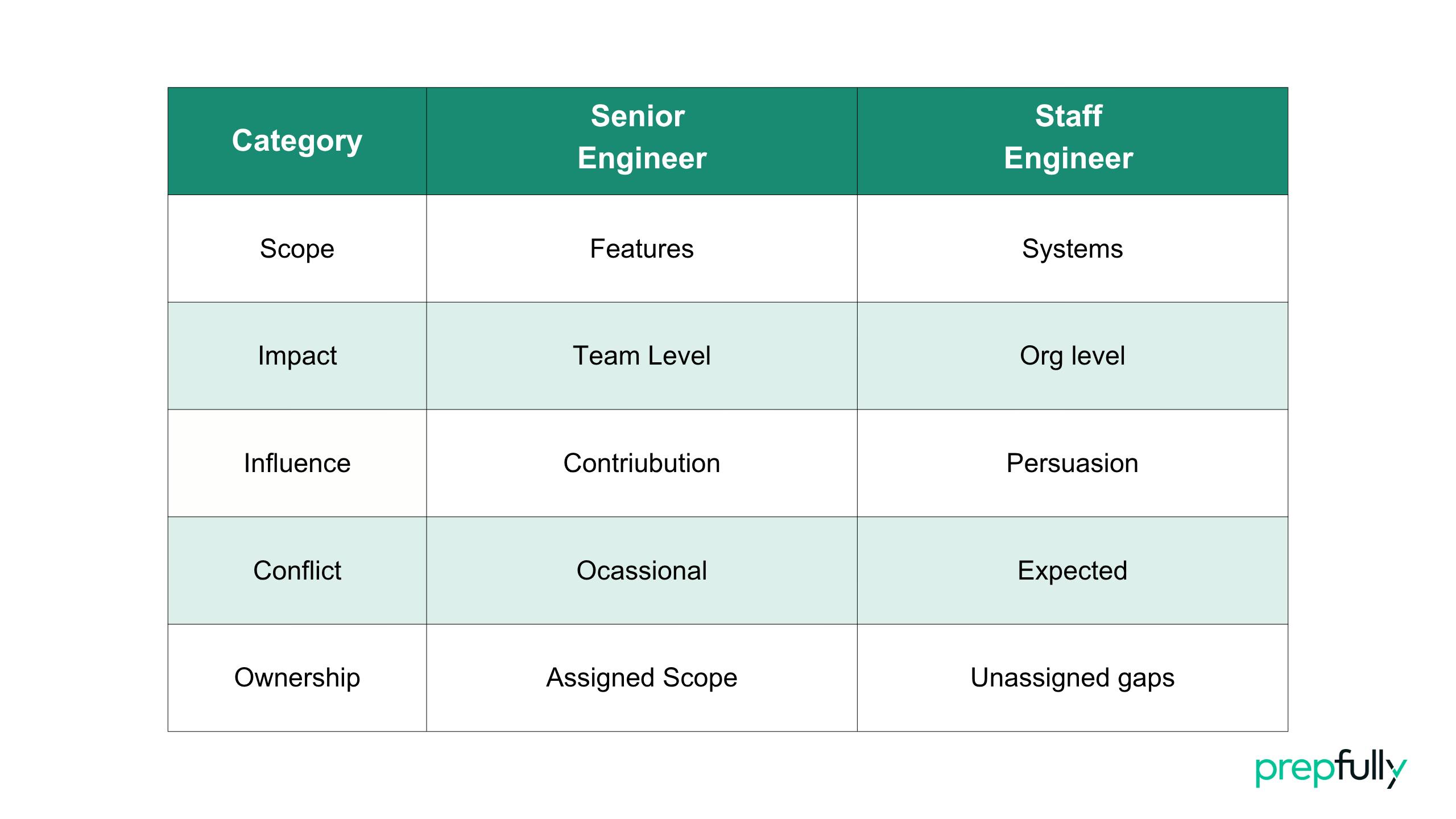
Most candidates fail because they are still telling linear stories to a panel listening for systemic ones.
That leads us nicely into…
Frameworks: Helpful, But Never the Point
Yes, STAR is a useful backbone.
But, adding Reflection elevates it. That’s how you think like a Staff engineer.
Use STAR + R to give clarity without sounding mechanical:
Situation >> Task >> Action >> Result >> Reflection
Reflection definitely makes you sound more passionate but also nails questions the interviewer is teeming to ask:
- How did this experience shape your technical philosophy?
- How did it alter your decision-making frameworks?
- What systemic lessons did you extract?
Now that we have a skeleton, let’s get to the meat of it.
Building a Proper Staff-Level Story Bank
You will need a repertoire of 15–20 stories.
Not because you will use them all—but because Staff engineering demands breadth.
Your bank should include stories that cover:
- stepping into leadership vacuums (ownership),
- influencing stakeholders who disagreed,
- architectural decisions under pressure,
- project failures and recoveries,
- large-scale migrations or reliability issues,
- mentoring senior engineers,
- navigating sustained ambiguity.
Your stories should feel grounded in reality, not theatrics. That’s accomplished when your stories are centred around these core themes.
Core Themes of a Staff Engineer
1. Ownership
The work at this level rarely comes with clear boundaries, so interviewers look for people who naturally take responsibility before being asked. It’s one of the strongest signals of true seniority.
2. Influence without authority
Much of the Staff role involves guiding people who do not report to you and may not initially agree with you. Interviewers expect to hear how you built trust, aligned conflicting priorities, and kept momentum without relying on title or hierarchy.
3. Technical judgment
Panels care less about the polish of your solution and more about the thinking that shaped it. Strong judgment shows in how you compare options, handle constraints, and make decisions that balance risk, cost, and long-term impact.
4. Conflict navigation
If your stories don’t include disagreements, you’re either omitting the truth or you’ve never worked on anything consequential. Staff engineers spend a surprising amount of time helping adults disagree productively. Avoiding conflict in your stories entirely is the surest sign you haven’t been operating at scale.
5. Ambiguity handling
Almost every Staff-level project begins as a blurry shape with a deadline attached. Interviewers want to hear how you turned that blur into something buildable—how you clarified goals, shaped constraints, and helped people see the same picture
This is an intellectual skill—state it proudly.
6. Failure
Failure at Staff level is not a scandal; it’s Tuesday. What matters is your ability to examine it honestly—no excuses, no dramatic self-flagellation—and explain what the situation taught you. Panels care less about the mistake and more about whether you grew sharper because of it.
7. Scale & complexity
Once you operate at Staff altitude, systems behave a bit like ecosystems: touch one part and something alarming rustles somewhere else. Interviewers want to hear how you kept complexity manageable, broke down sprawling problems, and made decisions that wouldn’t age like milk six months later.
Explain decompositions, risk mitigation, and long-term thinking.
8. Mentorship
Mentorship at Staff level isn’t about teaching someone a neat trick; it’s about raising the collective IQ of the room. Interviewers look for stories where your guidance changed how people reasoned, communicated, or approached problems. The goal is organizational uplift—not personal glory.
Also, seasoned interviewers can smell embellishment instantly. Honesty, of course, is non-negotiable in your stories.
The Ultimate Staff Engineer Behavioral Interview Prep Plan (6–8 Week Method)
Weeks 1–2: Build Your Story Inventory
Goal: Gather real stories that show how you think, lead, influence, decide, and recover when things go sideways.
What you do:
- List 20–25 meaningful projects from the past 3–5 years.
- Include wins, failures, half-successes, messy ones, and the ones that aged you.
- For each story, write what happened, why it mattered, who was involved, what was broken, how you handled uncertainty, and what you’d do differently now.
- Tag each story with Staff themes: influence, conflict, ambiguity, ownership gaps, architectural judgment, leadership without authority, crisis, recovery, trade-offs, long-term impact.
- Capture the “philosophy seeds”: the principles you used or the ones you wish you had.
New elements (Staff-critical):
- One story where you changed your mind.
- One story where the best technical solution wasn’t the right organisational one.
- One story where you gave up control so the team could grow.
Weeks 3–4: Shape, Structure, and Add Judgment
Goal: Turn raw memories into Staff-level narratives that show clarity, impact, and mature decision-making.
What you do:
- Shape each story into STAR+R (with real stakes and tension).
- Add constraints: headcount, deadlines, legacy systems, conflicting teams, blocked dependencies.
- Add metrics: reduced latency, improved reliability, cost savings, team unblocks, faster delivery.
- Add the “judgment layer”: the trade-offs you made, what you refused to do, risks you accepted or rejected.
- Write a leadership-philosophy line for each story (“What this taught me about Staff-level decisions”).
- Write a 1-paragraph summary showing your thinking, not just your actions.
New elements (Staff-specific):
- Document alternative solutions you considered.
- Highlight your role in cross-team alignment.
- Add a “future-proofing” note: how the experience shaped your long-term approach.
Weeks 5–6: Mock Interviews & Judgment Drills
Goal: Stress-test your stories with people who won’t let you hide behind tech jargon.
What you do:
- Do 4–8 mocks with senior or Staff-level interviewers.
- Ask them to interrupt you, challenge assumptions, question prioritization, and ask “Why not the other option?”
- Practice pivots: one story should answer 3–4 different questions.
- Train compression: the 30-second version, the 1-minute version, and the 3-minute version.
- Record yourself to analyse pacing, clarity, tone, and defensiveness.
- Practice hard questions:
“When did you misjudge someone?”
“When did you make a conflict worse?”
“When was your design rejected?”
“When were you wrong at the Staff scale?”
New elements (Staff-level):
- Do a mock with a difficult stakeholder role-play.
- Do a mock where you only answer why-questions.
- Do one session where you must answer with “principles first, story second.”
Weeks 7–8: Adaptation, Integration & Real-World Readiness
Goal: Become flexible, consistent, confident, and natural.
What you do:
- Practice answering variants: conflict, alignment, influence, ambiguity, impact.
- Create 3 versions of each story: the elevator, the 1-minute, and the full 3-minute version.
- Practice “story recombination” so one story can fit multiple themes.
- Build your theme-to-story map so every question has 2–3 backups.
- Remove unnecessary detail (no one needs Jira ticket IDs).
- Run 2–3 full mock interviews with a timer.
- Do a final polish: clarity, precision, reflection, tone.
New elements (final-week essentials):
- Run one mock when you’re tired — because interviews never happen on your best day.
- Practice resetting calmly when interrupted mid-thought.
- Practice admitting failure without oversharing or defending.
Staff Engineer Interview Readiness Scorecard
Rate yourself from 0–4.
Target: 28+ to be safely Staff-ready.
1. How many good stories do you actually have?
- 0: I have two stories. They are basically cousins.
- 1: I have a few more, but they all feel like sprint updates.
- 2: Decent mix, but with obvious holes.
- 3: Solid range across conflict, influence, failure, judgment.
- 4: 15–20 real stories I can pull up without panicking.
2. Can you tell a story clearly?
- 0: I narrate events. There is no point.
- 1: Some structure, but I wander.
- 2: Mostly clear, reflections are shallow-ish.
- 3: Clean beginning → middle → end, with actual thinking.
- 4: Sharp, thoughtful stories that show how I make decisions.
3. Do you talk about trade-offs?
- 0: “I built it.” Full stop.
- 1: I mention decisions, skip the why.
- 2: Some reasoning, not enough depth.
- 3: Good judgment, good reasoning.
- 4: I make it obvious I think in systems, not tasks.
4. Can you influence people who don’t report to you?
- 0: My “influence” stories involve people who had no choice.
- 1: I talk more about tasks than alignment.
- 2: Some influencing, a bit accidental.
- 3: Clear examples of getting buy-in.
- 4: I routinely shift teams, opinions, and direction.
5. Do you handle conflict without melting down?
- 0: “We never had conflict.” (Sure.)
- 1: My conflict stories are misunderstandings at best.
- 2: Some tension, not much insight.
- 3: Good examples of productive conflict.
- 4: Calm, clear, and actually helpful in tense situations.
6. Can you create clarity when things are messy?
- 0: I wait for someone else to fix ambiguity.
- 1: I move, but mostly in circles.
- 2: Some structure, not strategic enough.
- 3: I can shape direction.
- 4: I turn chaos into a plan everyone else can use.
7. Do you use numbers like a responsible human?
- 0: I avoid metrics like they owe me money.
- 1: Some numbers, mostly decorative.
- 2: Half real, half hand-wavy.
- 3: Clear, grounded metrics.
- 4: I have strong data that shows scale, stakes, impact.
8. Can you explain things in 30 seconds or 3 minutes?
- 0: I ramble until someone stops me.
- 1: Hit-or-miss clarity.
- 2: Usually fine, not consistent.
- 3: Good pacing.
- 4: Smooth, concise, adaptable even mid-interruption.
9. Do you sound like a human, not a script?
- 0: Over-rehearsed or flat.
- 1: Stiff.
- 2: Mostly natural, sometimes awkward.
- 3: Clear, grounded, confident.
- 4: Warm, credible, clear
10. Do you actually reflect on your past work?
- 0: No lessons. Just events.
- 1: Generic “I learned communication is important.”
- 2: Some insight, not deep.
- 3: Good sense of how experiences shaped you.
- 4: Clear growth, real lessons, and adult-level perspective.
Score Meaning
0–15: You’re gathering ingredients. Keep cooking.
16–23: Strong Senior energy. Staff altitude is not stable yet.
24–27: Almost there; polish the weak spots.
28–34: Staff-ready.
35–40: Principal-leaning. You think beyond the room.
Top 20 Staff Engineer behavioral Interview Questions
These appear across FAANG, unicorns, and major tech companies:
- “Tell me about a time you influenced a decision without authority.”
- “Describe a complex trade-off you had to make.”
- “What’s a disagreement you handled between teams?”
- “Tell me about a failure that changed how you operate.”
- “Describe a time you aligned stakeholders with conflicting priorities.”
- “Tell me about a long-term project that required sustained leadership.”
- “How do you create clarity in ambiguous situations?”
- “Tell me about a risk you identified that others didn’t see.”
- “What’s your approach to mentoring senior engineers?”
- “Describe a systemic issue you solved.”
- “Tell me about a time you pushed back on leadership.”
- “How do you balance velocity vs stability?”
- “Describe a time you had to de-escalate a conflict.”
- “What’s the most consequential decision you made?”
- “How do you handle cross-team dependencies?”
- “Tell me about a migration or large-scale refactor.”
- “Describe a moment you changed direction based on new information.”
- “What is your engineering philosophy?”
- “Tell me about a project where the architecture was contested.”
- “What’s your approach to long-term technical stewardship?”
Common Staff Engineer Mistakes
1. Hiding behind “We”
“We” is wonderful for teamwork, but disastrous for interviews. Panels are trying to understand your thinking, not the anonymous collective. Watch out for slipping into group camouflage—it erases your contribution and makes you sound like a passenger instead of a driver.
2. Avoiding metrics
Avoiding numbers makes even big accomplishments sound like tiny errands. Metrics don’t need to be perfect; they just need to show scale, stakes, or impact. Be kind to your future self. Give interviewers something real to latch onto, or they’ll fill in the blanks with assumptions you won’t like.
It’s just safe to mention one or two guardian metrics, so the interviewer knows you’re not only thinking about success metrics, but also the metrics that ensure you’re not harming the user experience.
3. Turning answers into a timeline instead of a decision
A surprising number of candidates narrate events like they’re reading from a project journal.Staff interviews aren’t about the sequence of what happened; they’re about the quality of your thinking while it was happening.
No sprint recaps.
4. Pretending everything was consensus-driven
Panels can smell manufactured harmony. Real Staff work involves friction—healthy, productive friction. If every story flows from perfect agreement to smooth delivery, interviewers assume you weren’t actually responsible for the decision-making.
5. Jumping straight to the solution
This is the Senior engineer giveaway. Seniors fix things. Staff engineers explain the messy lead-up: the ambiguity, the competing priorities, the trade-offs that made the solution non-obvious. When someone leaps directly from “problem” to “here’s what I built,” it suggests they haven’t operated in that uncomfortable space where the right answer isn’t clear.
6. Avoiding stories where you pushed back up the chain
Many engineers avoid talking about disagreements with PMs, managers, directors, or architects, usually out of fear of sounding confrontational or disloyal. But upward influence is a core expectation at Staff level. If every conflict you describe is lateral or downward, panels begin to wonder whether you’ve ever influenced strategy—or only execution.
7. Sounding so rehearsed you stop sounding real
Over-polished answers create a strange effect: the candidate sounds competent but unreachable. Staff interviews benefit from texture—moments where you were uncertain, where the choices weren’t obvious, where the trade-offs hurt a little. Perfect stories raise suspicions. Honest ones build trust.
8. Forgetting that engineering philosophy actually matters
A surprising number of engineers can explain what they did, but not why they tend to make decisions the way they do. Staff-level work is guided by principles; risk appetite, cost tolerance, quality boundaries. When that underlying philosophy doesn’t surface, interviewers can’t tell whether past decisions were intentional or accidental.
9. Selling personal effort instead of organizational impact
Some stories lean heavily on “I worked really hard,” “I was underwater,” or “I wore multiple hats.” Admirable effort, but Staff interviews aren’t grading stamina. They’re grading scale; who benefited, what changed, what risk decreased. Hard work without impact sounds more like a scheduling problem than a Staff-level accomplishment.
Advice is useful, but it only takes you so far; the rest comes from deliberate practice. Friends, AI, and self-reflection tend to give distorted feedback or focus on the wrong details.
You grow much faster by practicing with people who conduct these interviews for a living—people who can stop you, diagnose the issue, and show you how to fix it.
Final Thought: What Makes a Staff Engineer Truly Memorable?
They make hard things feel manageable for everyone else. Not by being the smartest person in the room (though they usually could be, if they wanted), but by making the room smarter.
If you can show interviewers that you don’t just solve problems—you stabilize the system around you—then you’re not just ready for the Staff role. You’re already doing the job most teams wish they had someone for.