Meta Software Engineer Interview: AI Assisted Coding Round
Meta has rolled out a new AI assisted coding round in October 2025. This replaces one of the traditional algorithmic interviews at the onsite stage. If you're preparing for a meta software engineer interview at the E4 or E5 level, there's a very good chance you'll face this format. Instead of racing through two LeetCode problems, you'll spend 60 minutes working with a real codebase and an AI assistant. This deepdive provides detailed guidance on Meta's new AI-Assisted Coding Round for Software Engineer roles.

What to expect in the Meta AI Assisted Coding Round
You'll get a CoderPad session with a chat sidebar where you can access a range of AI models. You can switch between them during the interview. You'll work with multiple files, dependencies, and configuration files like requirements.txt. This mirrors actual engineering work where you inherit code and extend it.
The AI assisted coding round will have one of the following three scenarios
- First scenario: building a feature directly into the existing structure
- Second scenario: extending partially implemented code
- Third scenario: debugging broken implementations.
… so overall reasonably different from typical LC style interviews.
How to use AI effectively in the Meta Software Engineer Interview
We have several recommendations on how best to use AI within the context of the Meta AI assisted coding interview. The AI is useful in providing boilerplate code, templates of classes, file parsing, and test cases. However, you should expect it to miss edge cases, or occasionally introduce once-off errors. It might also use inefficient algorithms, and (even though models are getting better and better at avoiding this), it can even hallucinate a method that is not there in your codebase.
It goes without saying: your interviewer watches every AI interaction in real time. They see your prompts, the AI's responses, and how you handle the output. This level of scrutiny is what makes this interview unique - rather than trying to figure out a way where they prevent candidates from cheating within interviews, Meta’s gone all in, and actively expects candidates to use AI, because ultimately using AI is now pretty much normalized as a way to accelerate your impact on-the-job anyway.
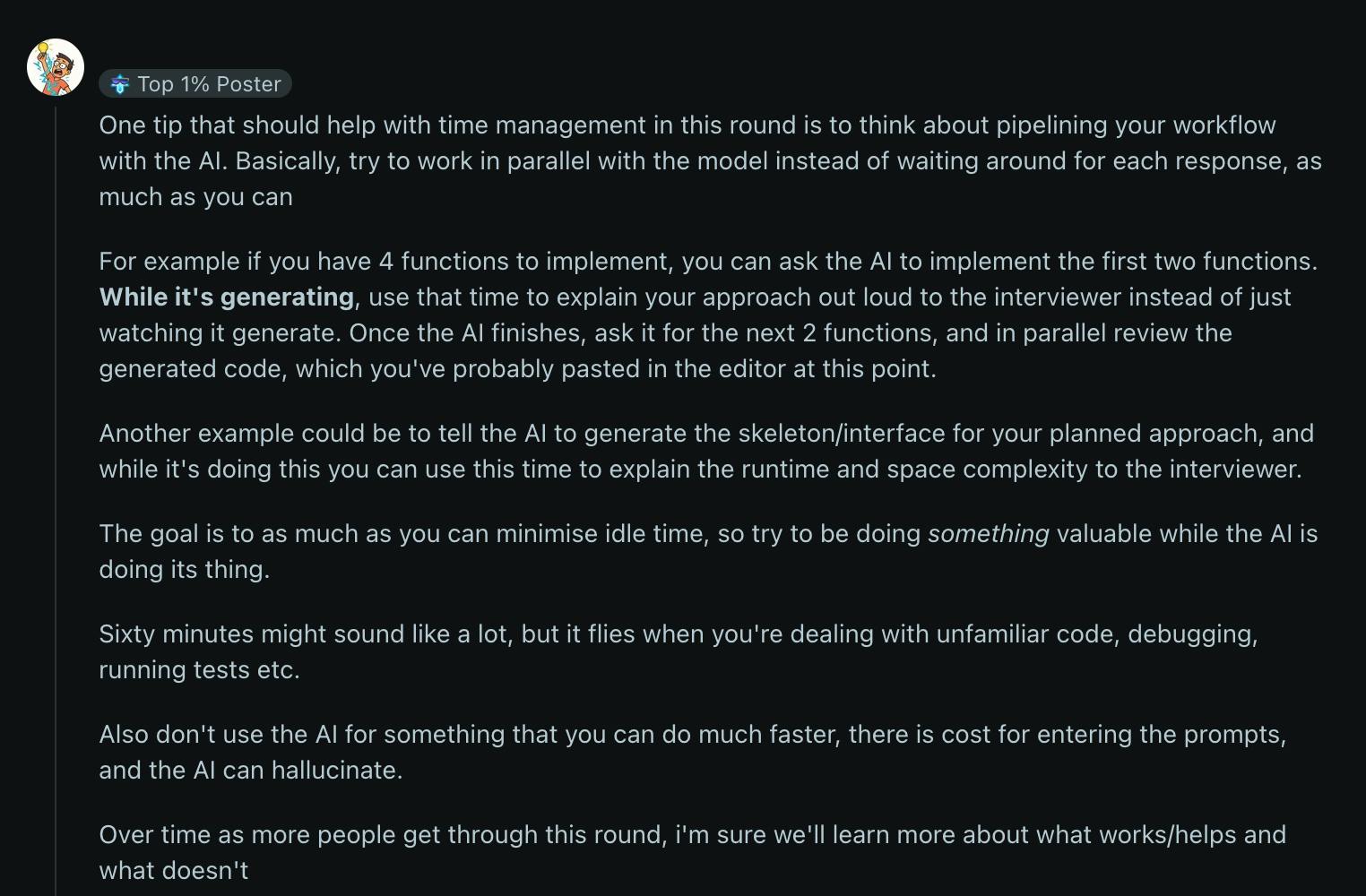
The smartest candidates use a pipelining strategy: ask AI to generate code for one part of the problem, then while it processes, explain your reasoning to the interviewer or review previous AI outputs. This way - you're not sitting idle waiting for responses. We heard from several Prepfully candidates who have gone through this format (and we also validated this via public forums where folks have shared their experience with their interview eg. on Reddit), that this parallel working approach really helped them maximize the “impact per minute” they were able to land with their interviewer. According to candidates who've taken this round on Reddit, this parallel working approach helps manage the 60-minute time constraint effectively.
How to prepare for the AI Assisted Coding Round
If you're preparing for a meta software engineer interview with the new format, the most obvious next step is to start going beyond LeetCode as your prep tool. You need to practice navigating multi-file codebases you didn't write. Clone small open-source projects on GitHub, spend 15 minutes understanding the architecture, then add a feature or fix a bug you intentionally introduce. Time yourself, because (even though real work doesn’t usually have unreasonable 30-45min deadlines), Meta interviewers definitely will expect you to surface something that works within the interview slot.
Run your code frequently. Get used to iterative debugging, write a bit, test it, fix what breaks, repeat. Don't wait until everything's "done" to execute. The round rewards candidates who catch issues early and fix them incrementally.
When you use AI during practice, don't blindly copy its output. Read every line. Ask yourself: does this handle empty inputs? What about large values or duplicates? The AI will miss edge cases, and your job is to catch them. Your interviewer expects you to understand and defend every line of code you submit, even if AI wrote it.
Meta recruiters can provide practice CoderPad sessions with the AI sidebar enabled. Request one from your recruiter, they are extraordinarily helpful (something relatively unique to Meta). Get familiar with how the models respond and which one works best for different tasks.
Want to practice? Try Prepfully's AI practice interviews to get feedback on your coding answers.
→ Schedule now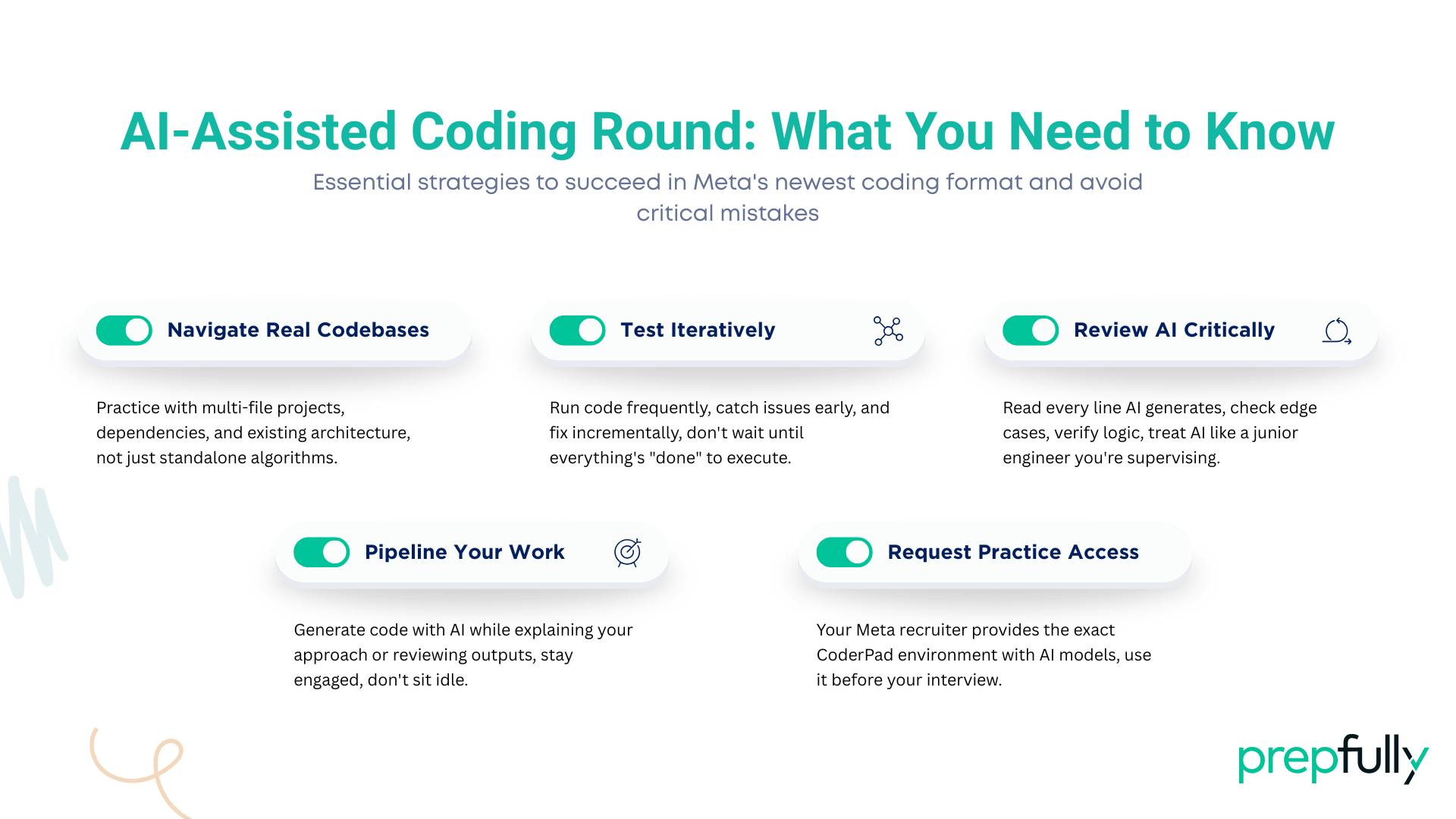
tl;dr - 4 tips for acing the Meta AI Assisted Coding Round
- Practice with multi-file projects, not just algorithms: The round tests your ability to navigate and extend existing code, not write from scratch.
- Treat AI as a junior engineer, not a solution generator: Review its outputs critically. Verify logic, check edge cases, and debug what it misses.
- Pipeline your work with AI: Don't wait idle. While AI generates code, review previous outputs or explain your approach to the interviewer.
- Request the practice CoderPad: Your recruiter can give you access to the exact environment with AI models enabled, use it before your meta software engineer interview.
Practice the new coding format with a Meta Software Engineer on Prepfully.
→ Schedule nowRecently reported Meta Software Engineer interview questions
<div class='problem-card'><h3>Alien Dictionary Order</h3><p>Derive the alien dictionary order from a sorted list of alien words.</p><div class='example'><p><strong>Input:</strong> words = ["z","x","z"]</p><p><strong>Output:</strong> "" (Empty String)</p><p><strong>Explanation:</strong> The letter 'z' cannot come before 'x' and then suddenly after 'x', creating a cycle and making the dictionary invalid.</p></div></div>
<div class='problem-card'><h3>Find the shortest path visiting all nodes in a graph.</h3><p>You have an undirected, connected graph of n nodes. Return the length of the shortest path that visits every node. You may start and stop at any node, you may revisit nodes multiple times, and you may reuse edges.</p><div class='example'><p><strong>Input:</strong> graph = [[1],[0,2],[1]]</p><p><strong>Output:</strong> 2</p><p><strong>Explanation:</strong> The graph is a straight line: 0-1-2. The shortest path visiting all nodes is 0 -> 1 -> 2, which requires 2 steps.</p></div></div>